
Stop Brick Efflorescence Returning: Brush, Test, Fix for Homeowners
Most brick efflorescence comes off with a stiff brush and clean water, and that alone solves the cosmetic problem in the majority of cases. Start with dry brushing and minimal rinsing, then run a quick solubility test before reaching for any cleaner. If the white haze returns within weeks, the issue is moisture, not dirt, and repair the entry point before treating the surface again. Recurring or large-area efflorescence is a job for a professional.
Quick Summary:
- Most efflorescence can be removed with dry brushing and minimal rinsing, but persistent or widespread cases may require professional cleaning and repair.
- Moisture entries from leaks, poor grading, or faulty flashing need fixing before cleaning to prevent recurrence, as salts return when water infiltrates the brick.
- Testing a small, inconspicuous section with water can determine if the efflorescence is soluble and respond to gentle cleaning methods or needs chemical treatment.
- Chemical cleaning, especially acid washes, should be used cautiously, with neutralization and proper safety precautions, and only as a last resort after testing.
- Regular maintenance like gutter clearing, proper water drainage, and periodic inspections help prevent new efflorescence from forming.
Table of Contents
- Brick Efflorescence Removal: What the White Powder Actually Is
- How Do You Tell What Kind of Efflorescence You Have?
- Removing Brick Efflorescence Step by Step
- Fixing the Moisture Problem So Efflorescence Doesn’t Come Back
- When Should You Call a Professional for Efflorescence?
- Publisher Perspective: Why Soft-Wash Plus Sealing Often Wins
- Safety Steps Before You Reach for Any Chemical Cleaner
- Assessing Efflorescence Severity Across Different Brick Types
- Keeping Brick Clean After Efflorescence Removal
- Editorial Take: Where Efflorescence Advice Usually Goes Wrong
- Get a Professional Assessment From Capital Pro Pressure Washing
- Sources
- FAQ
Brick Efflorescence Removal: What the White Powder Actually Is
Efflorescence is a crystalline deposit of water-soluble salts, usually calcium carbonate or sulfates, that migrate to the surface when moisture inside the brick evaporates. As the water leaves, it carries dissolved minerals with it, and those minerals crystallize once they hit air. This is why the white chalk on brick shows up most after a hard rain followed by a sunny, dry stretch.
It ranges from a faint dusty haze to a thick, crusty buildup that looks almost like frost. New construction often develops a temporary version called “new building bloom,” which comes from residual moisture in fresh mortar and usually fades within a season or two on its own. A persistent or thickening version, especially one that keeps returning to the same spot, points to an ongoing water source rather than a one-time event.
- Light dusting: usually new building bloom, low urgency
- Powdery patches that wipe off dry: classic soluble efflorescence
- Hard, crusty white buildup: salts that have carbonated into an insoluble form
- Localized streaking below a specific joint or fixture: likely an active leak
How Do You Tell What Kind of Efflorescence You Have?
Grab a spray bottle before you grab a brush. A few minutes of testing will save you from scrubbing at something that was never going to come off with water.
- Mist a small section with clean water and watch it for two or three minutes. If the white deposit visibly softens or disappears, it is soluble efflorescence and will respond well to dry brushing and rinsing.
- If the deposit barely changes when wet, it has likely carbonated into an insoluble form, sometimes called lime run, which needs more patience or a mild chemical approach.
- Walk the perimeter and check gutters, downspouts, grading, and irrigation heads near the affected wall. Interior leaks, poor flashing, and soil piled against the foundation are common culprits.
- Pick an inconspicuous 12-inch by 12-inch section and try your chosen cleaning method there first, waiting 24 hours to check results before treating the whole wall.
- If the salts are unfamiliar, oddly colored, or keep returning despite repairs, a masonry lab can identify the exact mineral, though this step is rarely needed for a typical residential wall.
Removing Brick Efflorescence Step by Step
Work from the gentlest method upward. Most homeowners never need to go past step one.
Dry brushing. Use a stiff fiber-bristle brush, never a wire brush, since embedded steel filings rust and leave new stains on the brick. Brush in a circular motion, collect the loosened powder rather than letting it fall into planting beds, then rinse lightly with a garden hose. This single step resolves the majority of light-to-moderate efflorescence.
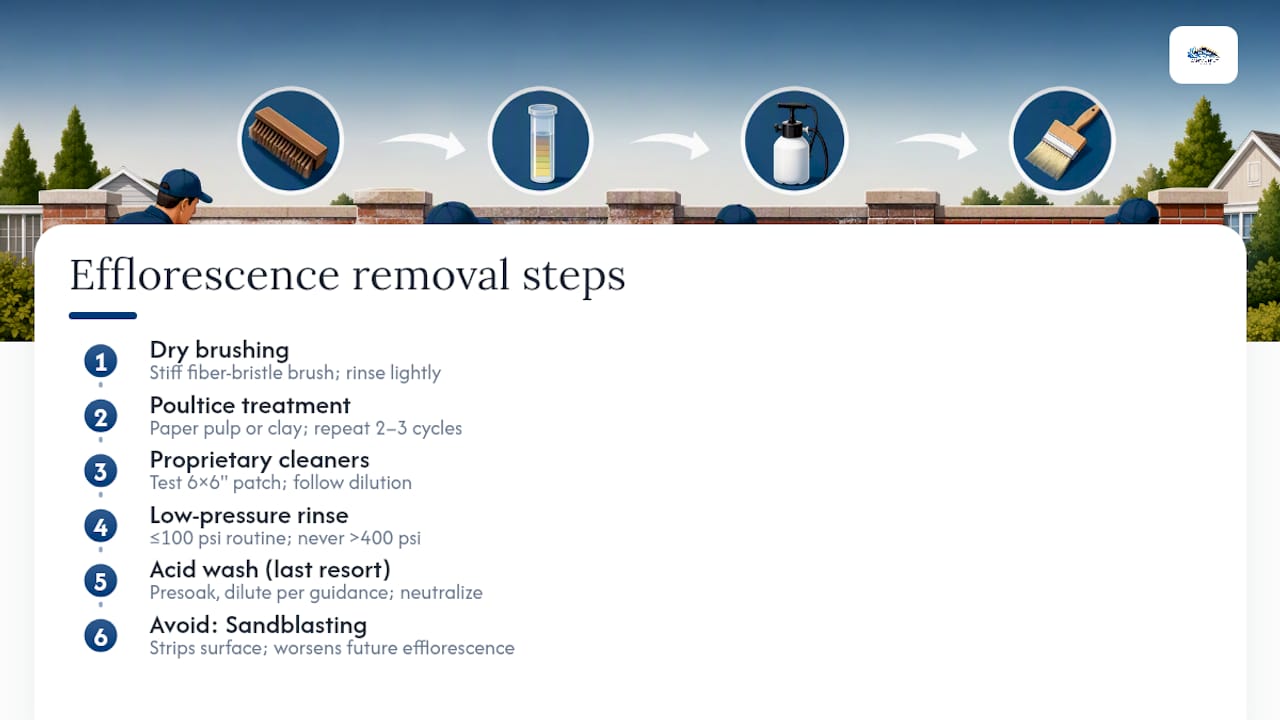
Poultice treatment. For soluble salts sitting deeper in the brick, a poultice of paper pulp or absorbent clay mixed with water draws the minerals out as it dries. Apply it, let it dry completely, then brush it off. Repeat the cycle two or three times for stubborn spots.
Proprietary masonry cleaners. Follow the manufacturer’s dilution and dwell-time instructions exactly, and always test a 6-inch by 6-inch patch first. This test-patch step is standard practice among professionals handling historic and modern masonry alike.
Low-pressure rinsing. If you rinse with a pressure washer, stay at or below 100 psi for routine cleaning and never exceed 400 psi on brick, using a fan tip held well back from the surface. Excess water pressure drives moisture and salts deeper into the masonry rather than removing them, which can worsen efflorescence over time.
Acid wash, as a last resort only. Diluted muriatic acid at manufacturer-recommended concentrations can dissolve carbonated salts that brushing won’t touch. Presoak the brick with clean water first so the acid doesn’t get pulled deep into the pores, apply to no more than 4 square feet at a time, and neutralize immediately with a baking soda solution followed by a full water rinse. Skipping neutralization can alter the wall’s pH and trigger secondary staining that’s harder to remove than the original efflorescence. Follow the dilution ranges recommended in industry guidance on efflorescence removal, never a stronger mix, and never on a whole wall without testing first.
Avoid sandblasting entirely. It strips the fired surface (the hard “skin”) off the brick, opening up pores that absorb water faster and invite worse efflorescence next season.
Pro Tip: If you’re not sure whether your efflorescence is fresh salt bloom or a sign of a leak, mark the spot with tape after cleaning it. If white powder reappears in the exact same location within two to three weeks, stop cleaning and start investigating water sources instead.
Fixing the Moisture Problem So Efflorescence Doesn’t Come Back
Cleaning treats the symptom. Repointing failing mortar joints, correcting flashing above windows and rooflines, and clearing weep holes stops the moisture that caused the salts to migrate in the first place. Skip this step and the same white haze will be back by the following spring.
Water management outside the wall matters just as much as repairs to the wall itself.
- Extend downspouts so they discharge at least 4 to 6 feet from the foundation
- Regrade soil so it slopes away from the house rather than toward it
- Adjust sprinkler heads that spray directly onto brick siding
- Clear gutters regularly so overflow doesn’t run down the wall face
Penetrating water repellents, typically silane or siloxane based, can reduce how much moisture the brick absorbs going forward. The key detail homeowners miss: these products need to let vapor pass through the wall, not just block liquid water from getting in. A film-forming coating that seals the surface completely can trap moisture already inside the brick, leading to subflorescence, salt crystallization beneath the surface that causes flaking and spalling. That’s a worse problem than the cosmetic haze you started with. If you’re weighing a stain or coating for a brick exterior, talk through the tradeoffs between finishes before committing to anything that fully seals the surface.
When Should You Call a Professional for Efflorescence?
Some situations are worth the cost of a contractor rather than a weekend of trial and error.
- The efflorescence covers a large section of wall, spans multiple stories, or keeps returning after two or three cleaning attempts.
- You see other signs of active water infiltration, damp interior walls, peeling interior paint, or a musty smell near the affected exterior wall.
- The brick is historic or unusually old, where aggressive cleaning risks permanent damage to soft or hand-formed units.
When you interview a contractor, ask directly whether they run test patches before committing to a full wall, how they neutralize and rinse chemical cleaners, and whether they have a written containment and disposal plan for runoff. Treat an insistence on sandblasting or wire brushing without a test patch as a red flag, and walk away from anyone who can’t describe their neutralization process in plain terms.
Publisher Perspective: Why Soft-Wash Plus Sealing Often Wins
Soft-wash cleaning uses low-pressure application and surface-safe detergents to lift both biological growth and surface salts without driving water deeper into the brick, the opposite risk of high-pressure blasting. Pairing that cleaning with a vapor-permeable penetrating sealant addresses the moisture uptake that caused the staining in the first place, rather than just erasing the symptom for a season. A reputable contractor will still run a test patch, document dilution and neutralization steps, and back the work with a satisfaction guarantee before touching the whole wall.
Safety Steps Before You Reach for Any Chemical Cleaner
Chemical masonry cleaners, even diluted ones, are corrosive to skin, eyes, and nearby plants. Treat every acid-based product as if it will burn something, because it will.
Wear chemical-resistant gloves rated for acid use, not standard dish gloves, along with splash-proof goggles and clothing that covers your arms and legs completely. A respirator rated for acid mist is worth the investment if you’re working in an enclosed courtyard or near an open window where fumes can drift indoors.
Wet down any nearby plants, grass, or garden beds with plain water before you start, and cover them with plastic sheeting if the wall is directly above them. Runoff from acid cleaners kills vegetation and can alter soil pH for a full growing season. Never mix cleaning products, especially acid-based cleaners with bleach-based ones, since the combination can produce toxic fumes.
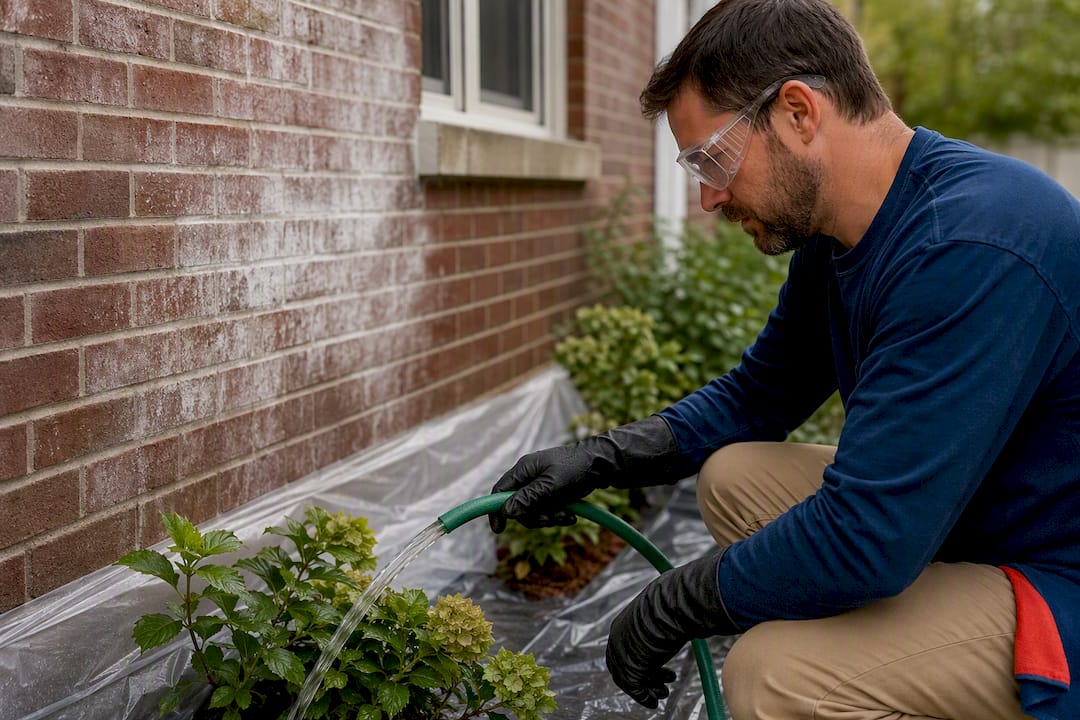
Work in sections small enough to rinse before the product dries on the brick, typically no more than 4 square feet at a time for acid washes. Keep a hose running nearby the entire time, and have a baking soda solution mixed and ready for immediate neutralization rather than mixing it after the acid is already on the wall. Rinse from the top down so runoff carries diluted product away from unwashed sections instead of staining them, and direct that runoff away from storm drains, lawns, and any water feature.
Assessing Efflorescence Severity Across Different Brick Types
Not all brick reacts to efflorescence, or to cleaning, the same way. Standard fired clay brick, the kind on most 20th century and newer homes, tends to develop light, powdery efflorescence that responds well to dry brushing since the fired surface is dense and less absorbent.
Softer, older, or hand-formed brick, common on homes built before the 1930s, absorbs moisture more readily and can develop thicker, more persistent salt deposits. This brick is also more vulnerable to damage from aggressive cleaning, so any chemical treatment should be tested on the smallest possible patch and given extra dwell time to work at a lower concentration.
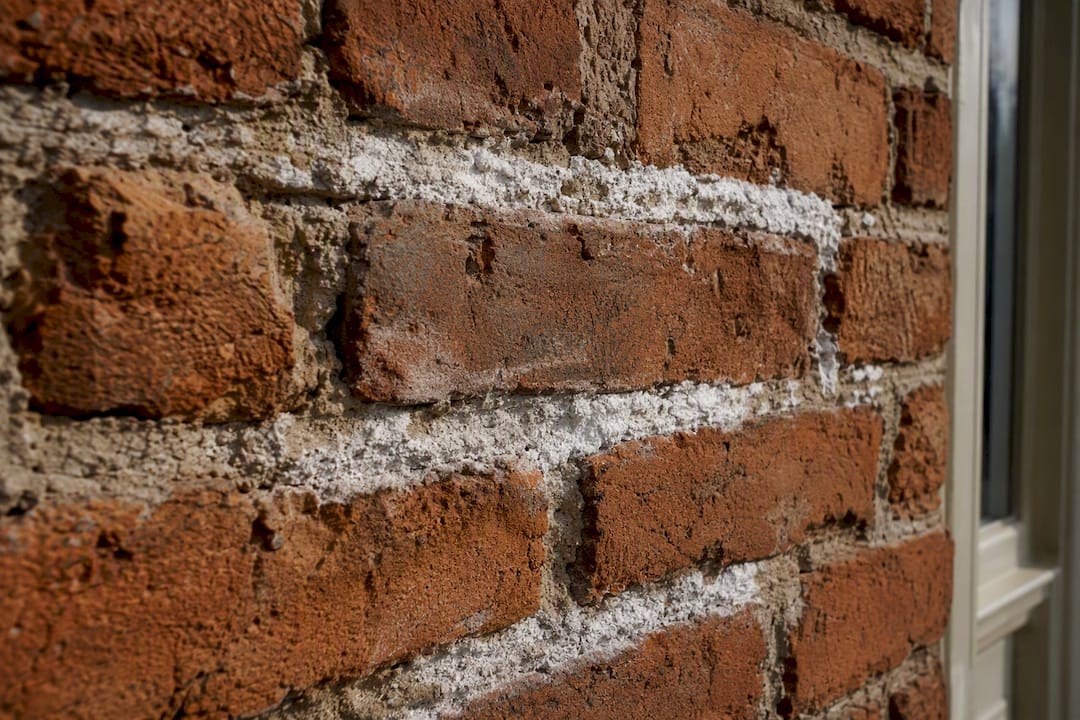
Concrete brick and paver-style masonry, often used on patios, retaining walls, and some newer facades, tends to show efflorescence as a broader haze rather than isolated crusty patches because the material is more uniformly porous throughout. If your efflorescence is on a patio surface rather than a wall, the cleaning approach shares the same gentle first, test always principle used on brick patios and paver surfaces.
To judge severity, look at coverage (a few isolated patches versus the entire wall face), thickness (a light dust versus a crust you can scrape with a fingernail), and recurrence pattern. A wall that stays clean for months after one brushing is a minor case. A wall that re-whitens within two weeks, every time, has an active water source that needs attention before more cleaning does any good.
Keeping Brick Clean After Efflorescence Removal
The work isn’t finished once the wall looks clean. Rinse the area again a day or two after any chemical treatment, since residual salts sometimes surface as the brick finishes drying out.
Walk the treated wall every few months for the first year, especially after heavy rain or a spring thaw, to catch any recurrence early while it’s still a light dusting rather than a thick crust. Keep gutters and downspouts clear on an ongoing basis, since a single clogged section can undo months of dry weather almost overnight.
If you applied a penetrating repellent, check the manufacturer’s reapplication window. Most products need refreshing every 5 to 10 years depending on exposure and product quality, and applying a new coat over a failing one without cleaning first traps whatever moisture and salt already got in underneath.
Avoid painting or applying a film-forming coating over brick that has any history of efflorescence unless the moisture source has been fully corrected. Sealing in a wall that’s still taking on water from a bad downspout or failed flashing just moves the salt problem underneath the surface, where you can’t see it until the brick starts spalling.
Editorial Take: Where Efflorescence Advice Usually Goes Wrong
Most guides treat efflorescence as a cleaning problem. It’s a plumbing problem wearing a cosmetic disguise. The internet is full of advice pushing homeowners straight to muriatic acid because it works fast, but speed isn’t the point. A wall cleaned with acid and no repair to the water source will look exactly the same in six months, minus whatever surface texture the acid etched away in the meantime.
The step people skip isn’t the cleaning, it’s the walk around the house checking gutters, grading, and flashing before they touch a brush to the wall. That five-minute inspection tells you more about whether you have a five-minute problem or a five-hundred-dollar one than any cleaner on the shelf. If there’s one piece of conventional wisdom worth pushing back on, it’s the idea that a stronger cleaner is a better cleaner. The research consistently favors the mildest effective method, tested small, applied patiently. Homeowners who skip the test patch and go straight to full-strength acid on a whole wall are usually the ones writing angry reviews about “ruined” brick a year later.
— Luis T
Get a Professional Assessment From Capital Pro Pressure Washing
If your efflorescence keeps coming back after a season of brushing and rinsing, the cheapest fix left is usually a real assessment, not another gallon of cleaner. A professional crew serving the Capital Region treats masonry with soft-wash methods built to lift salts and biological growth without driving water deeper into the brick, the mistake that turns a one-time cleaning into a recurring headache.

A typical visit starts with a walkthrough to spot the likely moisture source, a test patch to confirm the gentlest method that works on your brick, then cleaning, full neutralization, and an optional penetrating seal to slow the next round of staining before it starts. The same crew that quotes the job shows up to do it, and some jobs may carry satisfaction guarantees. Explore concrete and brick cleaning options or check sealing services for masonry that needs longer-term protection. Ready for a quote? Request an instant estimate and get an on-site assessment scheduled.
Sources
For homeowners who want the underlying technical guidance, the GoBrick technical note on efflorescence covers causes and prevention in detail, while NCMA TEK-08-03A lays out removal and dilution standards used by masonry professionals. The GSA’s masonry cleaning procedures detail mockup and test-patch protocols worth borrowing for any DIY project.
- Efflorescence – Causes and Prevention (GoBrick technical note)
- Control and removal of efflorescence – NCMA TEK-08-03A (CMHA reference)
- Myths about efflorescence — Prosoco
FAQ
Can You Remove Efflorescence From Brick?
Yes, most brick efflorescence removal starts with dry brushing using a stiff fiber-bristle brush and a light water rinse, which resolves the majority of cases. Stubborn or recurring deposits may need a poultice or a diluted, properly neutralized acid wash as a last step.
Can Efflorescence Be Removed Permanently?
Cleaning removes the visible salts but won’t stop them from returning if moisture keeps entering the brick. Permanent results require fixing the water source, whether that’s failing flashing, poor grading, or a leaking gutter, alongside the cleaning itself.
What Is the Most Effective Cleaner for Removing Brick Efflorescence?
Plain water and a stiff fiber-bristle brush handle most cases without any chemical product at all. For deposits that resist brushing, a diluted proprietary masonry cleaner or a carefully neutralized dilute acid solution works on carbonated, harder-to-remove salts, but always test a small patch first.
Does CLR Get Rid of Efflorescence?
General-purpose calcium, lime, and rust removers can loosen some efflorescence, but they aren’t formulated specifically for masonry and can leave residue if not fully rinsed. A dedicated masonry cleaner or a simple dry-brush and rinse approach is the safer first choice for brick.
How Much Does Professional Efflorescence Removal Cost?
Pricing depends on wall size, brick condition, and whether sealing is added afterward, so current rates are listed directly on the Capital Pro Pressure Washing pricing page rather than as a flat number here.
Recommended
Need a quote in the Capital Region?
Fast, free estimates from a local, licensed & insured team.
