
Homeowners: Inspect Asphalt Shingle Granules and Avoid Wash Damage
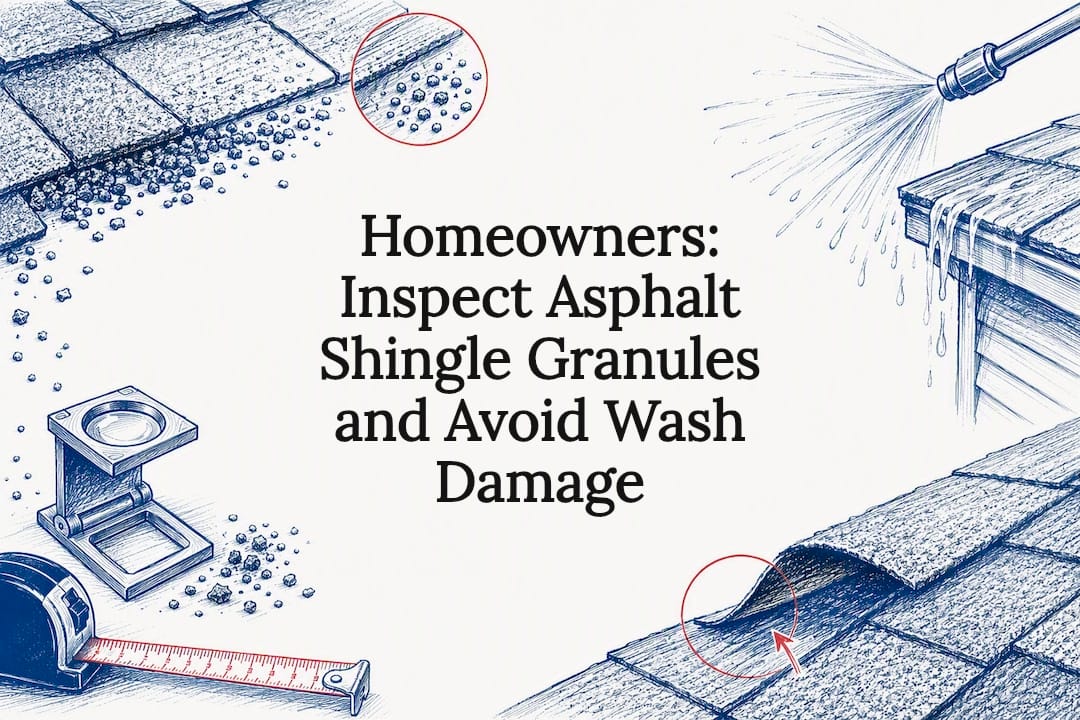
Asphalt shingle granules are ceramic-coated crushed stone that shields the asphalt mat from UV rays, adds fire resistance, and gives shingles their color. Modest, even granule loss is normal aging. Clustered bald spots, exposed black asphalt, or heavy granule deposits in your gutters after a storm mean it’s time to inspect the roof and figure out whether you’re looking at cosmetic wear or a warranty and insurance issue. The sections below walk through both.
Quick Summary:
- Granule loss from storms appears as scattered impact marks, while aging causes even, gradual wear on the roof surface.
- Heavy granule loss, exposed asphalt, or blistered patches typically indicate deterioration beyond cosmetic damage, often requiring full replacement.
- Checking gutters and simulating a visual inspection from the ground helps determine if granule loss is due to aging, impact, or manufacturing issues.
- Small bald spots can be temporarily patched with matching loose granules, but such fixes do not restore the shingle’s original durability.
- Pressure washing can accelerate granule loss unless a soft-wash method is used; always ask cleaning providers about their techniques and documentation.
Table of Contents
- What Do Asphalt Shingle Granules Actually Do?
- How Are Roofing Granules Made, and What Makes Them Durable?
- What Causes Granule Loss, and What Pattern Does Each One Leave?
- How Do You Inspect a Roof for Granule Loss?
- Repair, Replace, or File a Claim? What the Pattern Tells You
- Can You Patch or Replace Missing Granules Yourself?
- Does Cleaning Your Roof Strip the Granules?
- What Would I Check First If This Were My Roof?
- Keep Your Roof’s Granules Where They Belong
- Sources
- FAQ
What Do Asphalt Shingle Granules Actually Do?
Granules cover more than 97% of the surface of a typical fiberglass asphalt shingle, according to Interlock Roofing’s technical glossary. That coverage is not decorative padding. It is the shingle’s primary defense against the elements.
Each granule is a small piece of crushed stone with ceramic pigment baked onto its surface, then pressed into the hot asphalt coating during manufacturing. Once set, they perform several jobs at once:
- UV protection — blocking sunlight from breaking down the asphalt binder underneath
- Fire resistance — contributing to a shingle’s Class A fire rating
- Weight and ballast — helping shingles lie flat and resist wind uplift
- Color and curb appeal — the blend homeowners actually pick at the store
- Algae resistance — some granules are coated with copper or zinc compounds specifically to fight the blue-green algae that causes dark streaking
Once the mat underneath loses its granule cover in a given spot, that patch degrades far faster than the rest of the roof. Sunlight cooks the exposed asphalt, and that section becomes brittle years ahead of schedule.
How Are Roofing Granules Made, and What Makes Them Durable?
Manufacturers start with a specific base rock, crush it to size, coat it with ceramic pigment, and fire it in a kiln to bond the color permanently. IKO’s manufacturing overview notes that finished granules typically run between roughly 0.425 mm and 1.7 mm, a size range chosen for even coating and good asphalt adhesion.
Not every rock qualifies. Producers screen base stone for a specific set of traits:
- Hardness, so granules resist abrasion and hail impact
- Opacity to UV light, so they actually block radiation instead of just tinting the surface
- Low iron content, to avoid rust staining over time
- Low porosity and a cubical particle shape, both of which improve embedment in the asphalt
Industry testing backs this selection process. A conference paper on base-rock selection for roofing granules describes translucency, wet/dry, hardness, oil absorption, and rust testing as the standard battery manufacturers run before approving a quarry source. Translucency testing in particular predicts how much UV light a granule will let through over decades, which is a direct proxy for how long the shingle underneath will last.
What Causes Granule Loss, and What Pattern Does Each One Leave?
Not all granule loss means the same thing, and the pattern on your roof tells you which cause you’re dealing with.
- Normal weathering. Gradual, fairly even loss across a slope, often heavier along the paths where water runs off. This is expected aging and speeds up as a shingle nears the end of its service life.
- Hail or storm impact. Scattered, roughly circular bare spots with random distribution, frequently paired with small dents or bruises in the mat itself. InterNACHI’s inspection guidance treats this random, pockmarked pattern as the key visual signature separating storm damage from routine wear.
- Foot traffic and mechanical damage. Scuffed or thinned granules concentrated near valleys, vents, or anywhere someone walked, plus wear along shingle butt edges.
- Manufacturing or storage defects. Widespread bald patches on a roof that’s only a few years old, sometimes tied to a specific bundle or batch.
- Orientation and climate effects. South and west facing slopes typically shed granules faster than north facing ones because they take more direct UV exposure over the shingle’s life.
Pro Tip: After any hailstorm, check your gutters and downspout splash zones before you check the roof itself. A concentration of fresh granules in the gutter after a specific storm date is some of the strongest evidence an insurance adjuster will look for.
How Do You Inspect a Roof for Granule Loss?
Start from the ground, not the ladder. Binoculars and a walk around the perimeter will tell you most of what you need to know before you get up close.
- Look for uneven color patches or shiny, dark streaks that suggest the asphalt mat is peeking through
- Check gutters and downspouts for granule buildup, especially after storms
- Scan for blistering, curling tabs, or cracked butt edges near the granule loss
- Note which slopes are affected. Isolated one-slope loss points to sun exposure or a localized event; whole-roof loss points to age
If you do get closer, whether on a ladder or with a zoom lens, exposed black asphalt and soft, blistered patches are the clearest signs that granule loss has crossed from cosmetic into structural territory.
For severity, three questions matter more than a precise percentage: how much of the total roof area shows bare patches, whether other defects like cracking or curling accompany the loss, and how the roof’s age compares to its expected lifespan. A 22 year old roof shedding granules is a very different conversation than a 3 year old roof doing the same thing.
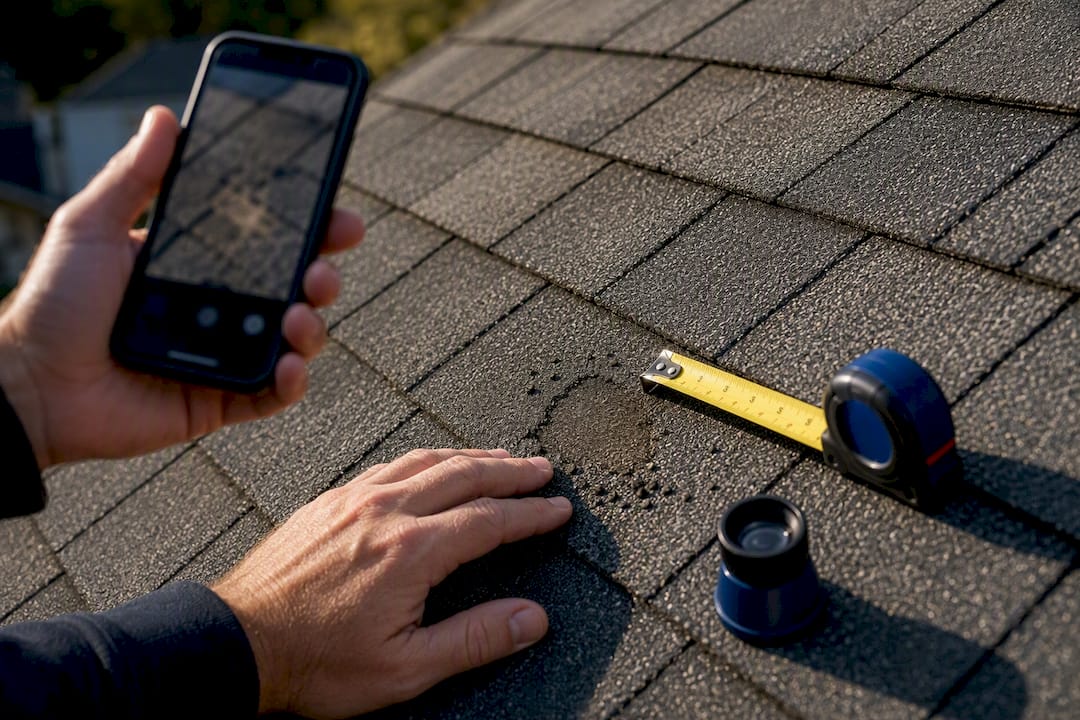
Pro Tip: Take photos from a consistent distance and angle each time you check the roof, and include something for scale, like a tape measure or a common object. Contractors and insurance adjusters both trust dated, comparable photo sets far more than a verbal description of “it’s gotten worse.”
Repair, Replace, or File a Claim? What the Pattern Tells You
Whether granule loss triggers a repair, a full replacement, or an insurance claim depends almost entirely on cause, not just severity.
Insurance adjusters lean heavily on pattern recognition. Random, scattered impact marks consistent with hail are typically treated as covered physical damage, while gradual, uniform granule loss from age is classified as normal wear and isn’t covered, according to CapOut’s insurance glossary. That distinction is worth understanding before you call your insurer, because it shapes what evidence you should gather first.
A few practical markers to weigh:
- Large areas of exposed black mat, especially with soft or blistered spots, usually mean replacement is closer than repair
- A young roof with isolated bald patches may point to a manufacturing or batch defect, which is a warranty conversation, not an insurance one
- Keep your installation date, shingle brand, and any batch numbers on file. Manufacturers ask for this if you pursue a defect claim
- When the pattern is ambiguous, get a roofer’s opinion before assuming either outcome
Can You Patch or Replace Missing Granules Yourself?
You can touch up small bare spots, but treat it as a cosmetic fix, not a durability fix. Roofing adhesive combined with matching loose granules, brushed or broadcast into the wet adhesive, can hide a small bald patch and slow further asphalt exposure in that exact spot.
Loose granules are sold in small bottles for spot repairs and in roughly 50 pound buckets for larger jobs or by professionals doing manufacturer-authorized repairs. Color matching is the real obstacle. Shingles fade and weather unevenly over the years, so a granule blend that matched perfectly at installation rarely matches an eight year old roof. Ask any supplier for a sample chip before buying in bulk, and match by the shingle manufacturer’s original color code whenever that information is available.
- Touch-ups bond less securely than factory-embedded granules and tend to wear or wash off faster in wind and rain
- They buy time; they don’t restore the shingle’s original protective life
- For anything beyond a few small spots, a professional repair or partial replacement is the more durable route
Does Cleaning Your Roof Strip the Granules?
It can, if it’s done the wrong way. High-pressure washing aimed directly at asphalt shingles is one of the fastest ways to accelerate granule loss, which is exactly why most shingle manufacturers list pressure washing as a warranty violation. Soft-wash roof cleaning, by contrast, uses low pressure and cleaning solutions to kill algae, moss, and biological staining without blasting the granule coat off the mat, as Capital Pro Pressure Washing’s guide to soft-wash roof cleaning explains.
Before hiring anyone to clean an asphalt shingle roof, ask a few pointed questions:
- Do they use soft-wash methods specifically, not a pressure washer with a wide-angle tip?
- Will they document the roof with before-and-after photos?
- Do they check gutters and downspouts as part of the job, not as an afterthought?
Pro Tip: If your roof is already showing granule loss, pair any cleaning visit with a quick inspection first. A roof rejuvenation treatment applied after cleaning can help restore some flexibility to aging asphalt, but it won’t put missing granules back.
What Would I Check First If This Were My Roof?
I’d start on the ground with binoculars, not on the roof with a hose. Check the gutters for granules, photograph any bald patches from a consistent angle, and note whether the loss looks scattered (storm) or even (age). Then match the pattern to the roof’s real age before deciding between a warranty call, an insurance claim, or a soft-wash cleaning to buy more years out of what’s already up there. If the pattern is unclear or the bare spots are large, call a roofer before you call anyone else.
— Luis T
Keep Your Roof’s Granules Where They Belong
There are companies in the Capital Region offering a warranty-safe alternative to pressure washing crews that use equipment which strips shingles’ granules on contact. This veteran-owned company has experience working on homes across the region and uses soft-wash techniques tailored to each surface instead of a single setting for every job.

For roofs already showing granule wear, that distinction matters. Soft-wash roof washing removes algae, moss, and streaking without accelerating the granule loss you’re trying to prevent, and the same crew that quotes your job is the one that shows up to do it. Visits are commonly supported by a satisfaction guarantee with free callbacks, and discounts may be offered to military and first responder households. If you’ve spotted bald patches, heavy gutter deposits, or just want a second opinion before your next storm season, check current pricing and request a quote to get a straight answer on what your roof actually needs.
Sources
- Interlock Roofing – Glossary: Granules
- Selection of base rock for roofing granules (IOP Conference Paper)
- Mastering Roof Inspections: Asphalt Composition Shingles, Part 34 (InterNACHI)
- Granule loss — Insurance & Xactimate Glossary (CapOut)
- IKO – Granules on shingles: their function and how they are made
FAQ
How Much Granule Loss Is Too Much?
There’s no single percentage that applies to every roof, but large, exposed patches of black asphalt mat, especially combined with blistering or curling, signal loss that’s moved past cosmetic. A roof nearing the end of its expected lifespan will naturally show more loss than a five year old roof with the same amount of bare shingle.
Can You Put Granules Back on Shingles?
You can add loose granules with roofing adhesive to patch small bald spots, but this is a cosmetic fix, not a full restoration of the shingle’s original protection. Color matching aged shingles is difficult, and the bond is weaker than the factory-embedded coating, so touch-ups tend to be short-term.
Is Granule Loss Covered by Insurance?
It depends on the cause. Random, scattered impact damage from hail is typically covered as physical damage, while gradual, uniform granule loss from normal aging is treated as maintenance and usually isn’t covered.
Do Granules Come Off a New Roof?
Some loose, excess granules shed off a brand new roof in the first weeks after installation, and this is normal. Widespread bald patches on a roof only a few years old are different and often point to a manufacturing or batch defect worth raising with the shingle manufacturer.
Recommended
Services Related To This Article
Need a quote in the Capital Region?
Fast, free estimates from a local, licensed & insured team.
