
Freeze-Thaw and Salt: Why Capital Region Driveways Fall Apart (and How to Stop It)
Spalling, pitting and flaking concrete in Albany, Schenectady and Saratoga — what causes it, what can be saved, and how sealing prevents it.
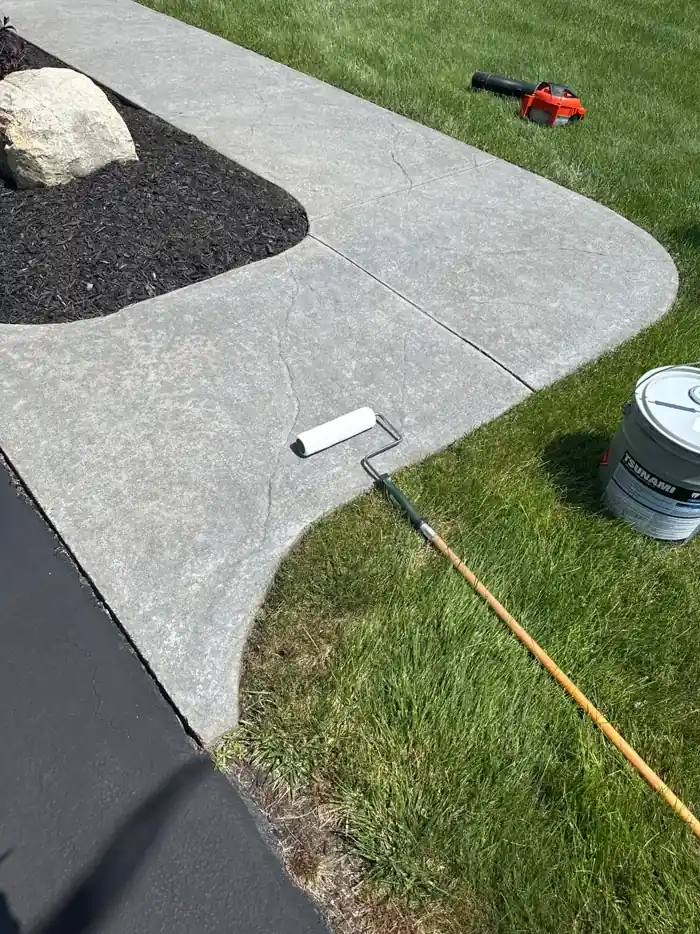
Every April, Capital Region homeowners walk out to a driveway that looks like the top layer peeled off. It isn't bad luck and it usually isn't bad concrete. It's water, salt, and the dozens of freeze-thaw cycles this region puts a slab through every winter.
What's Actually Happening to the Slab
Concrete is porous. Meltwater and brine soak into those pores, and when temperatures drop the water freezes and expands roughly 9%. That expansion happens inside the concrete, pushing the surface layer apart from within. Repeat that dozens of times each winter and the top layer separates — that's spalling.
Deicing salt makes it worse in two ways: it drives more freeze-thaw cycling by repeatedly melting and refreezing the surface, and chloride penetration attacks the concrete matrix and any reinforcement below.
- Flaking or peeling top layer (spalling)
- Small pockmarks across the surface (pitting)
- White chalky residue (efflorescence)
- Crumbling edges along the apron and steps
Why This Region Is Especially Brutal
The Capital Region doesn't just get cold — it hovers around freezing for long stretches, cycling above and below 32°F far more often than colder, more stable climates. Albany, Schenectady, Troy and Saratoga County crews also salt heavily, and driveways catch plow spray off the road on top of whatever you apply yourself.
That combination is why an unsealed 10-year-old driveway here can look worse than a 25-year-old slab in a drier climate.
What Sealing Does — and What It Can't Fix
A penetrating sealer soaks into the pores and forms a hydrophobic barrier inside the concrete. Water beads and runs off instead of soaking in, so there's far less water present to freeze. Chlorides are blocked from migrating down. Stains sit on the surface instead of absorbing.
What sealing cannot do is rebuild concrete that has already spalled. Once the surface layer is gone, sealing slows further loss but does not restore what's missing. That's the honest answer, and it's why sealing before damage starts is the whole game.
The Pre-Winter Routine That Actually Works
Clean the slab properly with a rotary surface cleaner so nothing is sealed in, treat any staining individually, let it dry through, then apply a penetrating sealer. We use Trident Break Wall for 5-year protection and Sea Wall for 7-year protection on drives that take the most abuse.
Then go easy on the salt. Sand for traction, shovel early, and keep deicer off freshly sealed concrete for the first season.
Ready for a Free Quote?
Fast callback. No pressure, no obligation.
FAQ
Frequently Asked Questions
My driveway is already flaking — is sealing pointless?
Not pointless, but be realistic. Sealing slows further deterioration on a spalled slab; it does not restore the lost surface. We'll tell you on site whether sealing is worth it or whether you're better off budgeting for replacement.
How long does concrete sealing last?
Our Trident Break Wall system is rated 5 years and the premium Sea Wall system 7 years, assuming the slab was properly cleaned and dry at application.
Will sealer make my driveway slippery?
No. Penetrating sealers cure inside the concrete rather than forming a film on top, so surface texture and traction are unchanged.
What kind of deicer is safest on concrete?
Plain sand for traction is safest. If you must melt, calcium magnesium acetate is gentler than rock salt — and avoid any deicer on concrete less than a year old.
Serving The Capital Region
Get It Done In Your Town
- Concrete Cleaning in Albany, NY
- Concrete Cleaning in Schenectady, NY
- Concrete Cleaning in Saratoga Springs, NY
- Concrete Cleaning in Troy, NY
- Concrete Cleaning & Sealing in Clifton Park, NY
- Concrete Cleaning & Sealing in Rensselaer, NY
- Concrete Cleaning & Sealing in Colonie, NY
- Concrete Cleaning & Sealing in Latham, NY
Get Started
Get Your Free Quote
Takes about a minute. No obligation — we'll text or call you back fast.
