
20 Minute Exterior Window Cleaning for Homeowners, Stay Off Ladders

Most ground-level windows are a DIY job. Grab a squeegee, distilled water, and 20 minutes, and you’ll get streak-free results without spending a dime on a pro. But once you’re dealing with a second story, a steep roofline, mineral-crusted glass, or a ladder you’re not confident on, the math flips. The cost of a fall or a cracked seal outweighs whatever you’d save doing it yourself, and that’s where a professional crew earns its fee.
Quick Summary:
- Professional window cleaning ensures safe access for second-story and steep roof windows, avoiding fall risks and potential damage from improper ladder use.
- Purified-water systems and soft-wash techniques provide streak-free results, especially for upper-floor glass and mineral deposit removal.
- Timing for the best results is during overcast conditions in spring or fall, with frequent cleaning every 1 to 6 months depending on exposure and debris buildup.
- DIY methods work for ground-floor windows, but heavy buildup or hard-to-reach panes typically require professional equipment and experience for optimal results.
- Combining professional cleaning for upper levels with DIY for low, accessible windows can balance cost, safety, and long-lasting cleanliness.
Table of Contents
- What Tools and Cleaning Solutions Do You Actually Need?
- How Do You Wash Exterior Windows Like a Pro?
- When Should You Clean Windows for Best Results?
- Is It Safe to Climb a Ladder for Window Cleaning?
- How Do You Remove Hard Water Spots and Mineral Deposits?
- How Do You Clean Frames, Tracks, and Screens?
- When Does It Make Sense to DIY vs. Hire a Pro?
- What Makes Professional Window Cleaning Different?
- A Homeowner’s Bottom Line on Exterior Windows
- Get Streak-Free Windows Without the Ladder Risk
- Sources
- FAQ
What Tools and Cleaning Solutions Do You Actually Need?
You don’t need a truck full of gear.
- Squeegee — the tool that actually removes water and grime in one pass, rather than smearing it around.
- T-bar or scrubber with a microfiber sleeve — loosens dirt and pollen before the squeegee comes in.
- Extension pole — gets you to second-story glass from the ground, no ladder required.
- Bucket and a soft-bristle brush — for tracks, sills, and frames.
For solution, warm water with a few drops of mild dish soap cleans most everyday grime. For heavier buildup, a 1:1 mix of white vinegar and water cuts through mineral film and bug residue better than soap alone. Skip ammonia-based cleaners on coated or Low-E glass, since they can degrade the coating over time, and never use abrasive pads. Test any new solution on a small corner first. One detail most homeowners miss: pros rinse with purified or deionized water specifically because it carries no dissolved minerals, so it air-dries spot-free without a squeegee pass. Straight tap water, especially hard water, leaves the faint white film you’re probably trying to remove in the first place.
How Do You Wash Exterior Windows Like a Pro?
Technique matters more than product. Here’s the order that actually works:
- Pick your window. Cloudy days or shaded hours beat full sun, since direct sunlight dries the solution before you can wipe it off, leaving streaks behind.
- Prep the area. Pull the screens, check the frame and seals for damage, and clear cobwebs or loose debris from the corners.
- Rinse first. A gentle hose stream (never a pressure washer) knocks off loose dirt and grit so you’re not grinding sand into the glass with your scrubber.
- Scrub with your solution. Work the T-bar or microfiber scrubber in overlapping strokes, covering the whole pane edge to edge.
- Squeegee at a 45-degree angle. Start at a top corner and pull down and across in one smooth stroke, overlapping each pass by about 2 inches. Wipe the blade dry after every stroke, or you’ll just drag dirty water back across clean glass.
- Detail the edges. A dry microfiber cloth catches the drip line along the frame before it dries into a streak.
- Move to the next pane and repeat, one window at a time.
Pro Tip: Work fast once you apply solution to a pane. If it sits too long and starts evaporating, you’ll fight streaks no matter how good your squeegee technique is. Better to do one window right than four windows half-dry.
Finish by reinstalling the screens and giving the glass one last look in raking light, which shows streaks that direct light hides.
When Should You Clean Windows for Best Results?
Timing affects the finish almost as much as technique. Early morning or late afternoon works best, and overcast skies beat sun every time, since heat speeds up evaporation before you can squeegee it clean.
For full exterior cleanings, spring and fall are commonly recommended cleaning seasons. Both seasons avoid the freeze risk of winter and the flash-drying heat of midsummer.
Frequency depends heavily on exposure:
- Typical suburban homes: every 3 to 6 months keeps glass clear without much effort.
- Coastal properties, homes near busy roads, or houses with pets and mature trees: every 1 to 3 months, since salt spray, road film, and organic debris build up much faster.
- Anywhere else: spot-clean between full washes when you notice pollen film or bird droppings.
Whatever your schedule, work one window at a time rather than soaping up the whole house at once. Solution left sitting too long evaporates unevenly, and that’s the single fastest way to undo good technique.
Is It Safe to Climb a Ladder for Window Cleaning?
Ladder safety is where most DIY window cleaning goes wrong. A few rules keep the job from becoming an ER visit:
- Use ladder stabilizers or standoffs so the rungs don’t rest directly against the glass or gutter.
- Keep three points of contact and never lean or overreach to hit a spot just out of range; move the ladder instead.
- Set the ladder at the proper angle (roughly one foot out for every four feet of height).
- If the window is above a second story, over a steep slope, or requires awkward positioning to reach, that’s your signal to stop and call a professional.
Skip the pressure washer entirely. High-pressure water can force its way past seals and glazing, leading to leaks or fogged panes down the line. A gentle hose rinse is the safer alternative for loosening dirt before you scrub.
Professional crews solve the access problem differently: purified-water fed poles reach upper floors from the ground, and insured teams use lifts for the jobs where a ladder simply isn’t the right tool.
How Do You Remove Hard Water Spots and Mineral Deposits?
Mineral spots respond to patience more than muscle. A stronger vinegar solution, or a commercial hard-water remover, applied gently and left to sit for a few minutes before rinsing thoroughly, clears most residue.
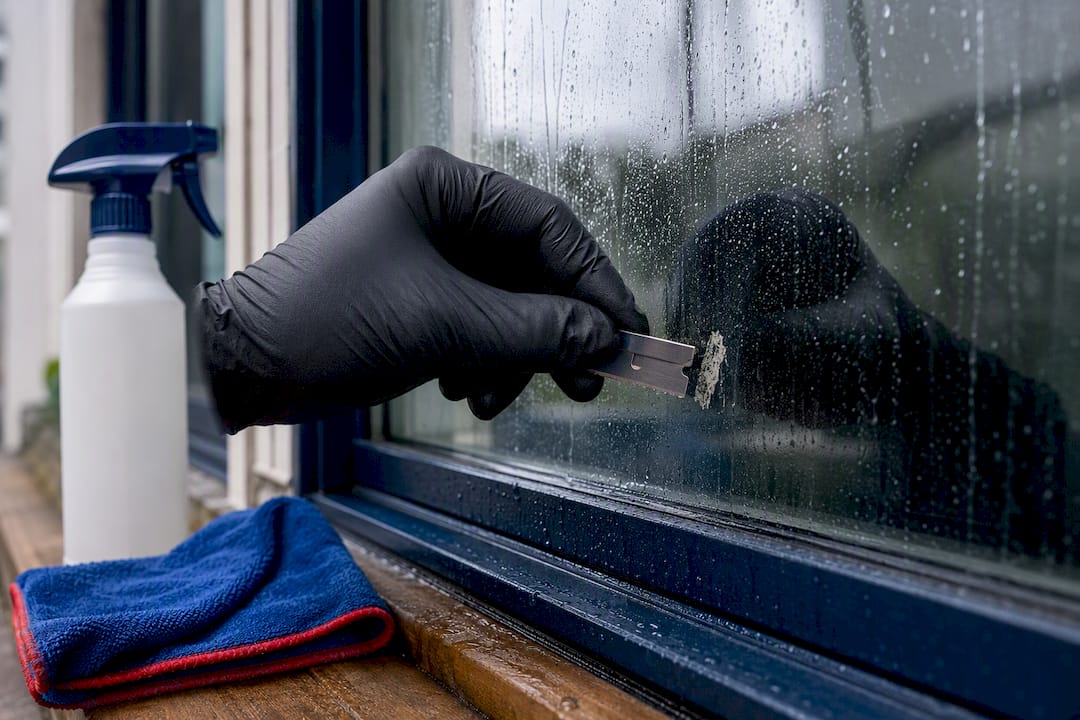
For crusted-on deposits, a careful wet razor scrape can lift mineral buildup, but only on wet glass with a proper glass-rated blade. Scraping dry glass, or using the wrong blade, scratches the surface permanently.
There’s one limit no amount of scrubbing fixes: if you see fogging or haze between the panes of a double-pane window, that’s a failed seal, not a cleaning problem. The unit needs replacement. Decades of mineral saturation, or glass that’s been neglected for years, is also where it makes sense to bring in a professional with commercial-grade treatments rather than keep fighting it yourself.
How Do You Clean Frames, Tracks, and Screens?
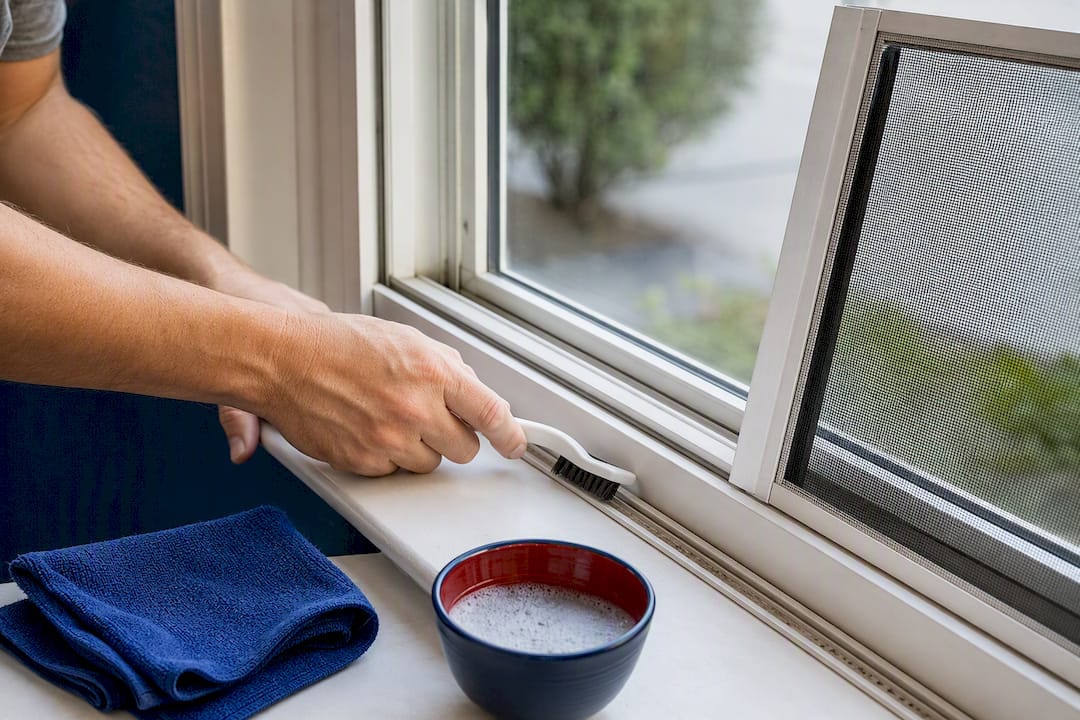
Glass is only part of the job. Remove screens and rinse them separately, then scrub both the screen frame and window frame with mild detergent, letting everything dry fully before reinstalling. Vacuum or brush tracks first to clear grit, then follow with a small brush and mild soap for embedded grime. Wood trim needs a gentler touch than vinyl, and Low-E coated glass should never see ammonia. While you’re at it, check the weatherstripping and seals for gaps that let in drafts or moisture.
When Does It Make Sense to DIY vs. Hire a Pro?
Run through this checklist before you decide:
- Window count and height: a handful of ground-floor windows is a Saturday project; a two-story house with a dozen panes is a bigger commitment.
- Current condition: light dust is easy; years of mineral buildup or algae calls for stronger tools.
- Time and physical ability: ladder work isn’t for everyone, and that’s fine.
- Cost comparison: a basic DIY kit costs a moderate amount, enough for most basic window cleaning supplies, while professional equipment and purified-water systems cost far more upfront but deliver longer-lasting, spot-free results.
A hybrid approach often makes the most sense: handle the easy, low windows yourself and bring in a pro for the second story or anything requiring specialized access. Professionals also bring insurance and faster turnaround, which matters if you’re prepping for a sale or an event.
What Makes Professional Window Cleaning Different?
Soft-wash methods, the approach Capital Pro Pressure Washing uses across the Capital Region, rely on low pressure paired with specific detergents that lift mold and mildew without stripping seals or frame finishes. That distinction matters on older homes where aggressive cleaning has already worn down caulking.
- Cleaning paired with sealing services extends how long windows and trim stay clear of new growth.
- Purified-water systems eliminate the mineral spotting that plagues tap-water DIY jobs.
- Trained crews follow documented safety protocols on ladders, lifts, and pole systems.
- Satisfaction guarantees back the work, giving homeowners a fallback if results fall short.
A Homeowner’s Bottom Line on Exterior Windows
The biggest mistake I see homeowners make isn’t skipping the vinegar recipe or buying the wrong squeegee. It’s underestimating what a ladder and a second story actually demand. Start with this: rinse before you scrub, work in shade, squeegee at 45 degrees, and stop the moment a window is out of comfortable reach. If that describes your upstairs glass, Capital Pro Pressure Washing is worth a call.
— Luis T
Get Streak-Free Windows Without the Ladder Risk
Skip the ladder, the mineral spots, and the guessing on solution ratios. Capital Pro Pressure Washing brings purified-water systems and soft-wash technique to every job across Albany, Schenectady, Saratoga, and the surrounding Capital Region, so upper-story glass comes out spot-free without anyone risking a fall.

Beyond windows, the same crew handles house washing and broader exterior cleaning services, so you can bundle a full soft-wash with your window cleaning in one visit instead of scheduling separate contractors. That’s the real advantage over the DIY route on anything above ground level: one insured team, one appointment, no ladder in your trunk. If your home has second-story windows, heavy mineral buildup, or you just want the purified-water finish without buying the equipment, check current pricing and get a quote for your address.
Sources
For more on timing, DIY solutions, and purified-water systems, see RealSimple, Marvin’s washing guide, and Unger’s pure water systems. For scheduling help, see how often to pressure wash your house.
- Is There a Right Time to Clean Your Windows? — RealSimple
- The Best Way To Wash Windows (Like the Pros) — Marvin
- How to Clean Your Outside Windows in 5 Easy Steps — The Spruce
- Pure water cleaning systems — Unger USA
- How often should you clean windows? — CleaningBro
FAQ
What Is the Best Way to Clean Outside Windows?
Rinse off loose grit with a gentle hose stream, wash with a mild soap or vinegar solution using a T-bar or scrubber, then squeegee at a 45-degree angle in overlapping strokes, wiping the blade dry between each one.
How Much Does It Cost to Get Outside Windows Cleaned?
Costs vary by window count, height, and condition; a basic DIY kit runs about $20 to $60 in supplies, while professional pricing depends on the job, so it’s worth checking a detailed cost guide for an accurate range.
What Should You Use to Clean Windows From Outside?
A squeegee, microfiber-covered scrubber, and either mild dish soap in warm water or a 1:1 white vinegar and water solution for tougher grime handle most jobs without damaging glass or frames.
Is It Worth Getting Your Outside Windows Professionally Cleaned?
For ground-level windows, DIY works fine and saves money. For second-story glass, heavy mineral buildup, or homes near the coast or busy roads, professional soft-wash and purified-water cleaning deliver longer-lasting, spot-free results without the ladder risk.
Recommended
Services Related To This Article
Need a quote in the Capital Region?
Fast, free estimates from a local, licensed & insured team.
