
Holiday Light Installation Cost: 2026 Pricing Guide
Quick Summary:
- Professional holiday light installation in the U.S. averages around $442, usually costing between $220 and $685 depending on home size and services. Labor costs significantly influence the total, with prices varying by linear footage, complexity, and regional factors, and a detailed, itemized quote is essential to avoid surprises. Permanent lighting systems are available but cost more upfront, paying off over several years, while DIY is suitable only for simple, accessible roofs and those comfortable with ladders and safety.
Professional holiday light installation for U.S. homeowners typically costs around $442 on average, with most residential jobs falling between $220 and $685, depending on home size and service level. Labor-only installs commonly price at a few dollars per linear foot; all-in packages (installer supplies the lights) generally cost higher per foot, and premium custom displays can be more expensive in high-cost metros. For a straightforward single-story roofline, expect to spend a few hundred dollars. A two-story home with wrapped trees and a timer system will typically cost more, often significantly higher. Hiring a professional is worth it when your roofline is steep or tall, when you want guaranteed in-season repairs, or when you simply don’t want to spend a weekend on a ladder in November. Capital Pro Pressure Washing offers holiday lighting installation across New York’s Capital Region, covering design through takedown.
Labor is a major part of a typical holiday lighting project cost — which means the cheapest quote often reflects cut corners on service, not a better deal.
Table of Contents
- How much does holiday light installation cost by pricing model?
- What factors change your holiday lighting quote the most?
- What should a professional holiday lighting quote include?
- Should you DIY or hire a pro?
- How to estimate your own holiday lighting cost
- Permanent vs. seasonal installation: which makes more sense?
- Key Takeaways
- The case for not cutting corners on holiday lighting
- Capital Pro Pressure Washing handles holiday lighting from start to finish
- Useful sources
- FAQ
How much does holiday light installation cost by pricing model?
Installers use three main structures: per linear foot, hourly rates, and flat packages. Each has its place, and knowing which one you’re being quoted helps you compare bids accurately.
| Pricing Model | Typical Rate | What’s Usually Included |
|---|---|---|
| Labor-only per foot | $2–$5/ft (up to $7 in expensive metros) | Installation of homeowner-supplied lights |
| Standard full-service per foot | $5–$7/ft | Installer-supplied commercial lights, clips, timers, install |
| Premium per foot | $7–$12/ft | Custom design, premium LEDs, complex rooflines |
| Hourly crew rate | Varies by market | Used for irregular jobs or add-on work |
| Flat seasonal package | $100–$400 | Lights, install, takedown; no storage needed |
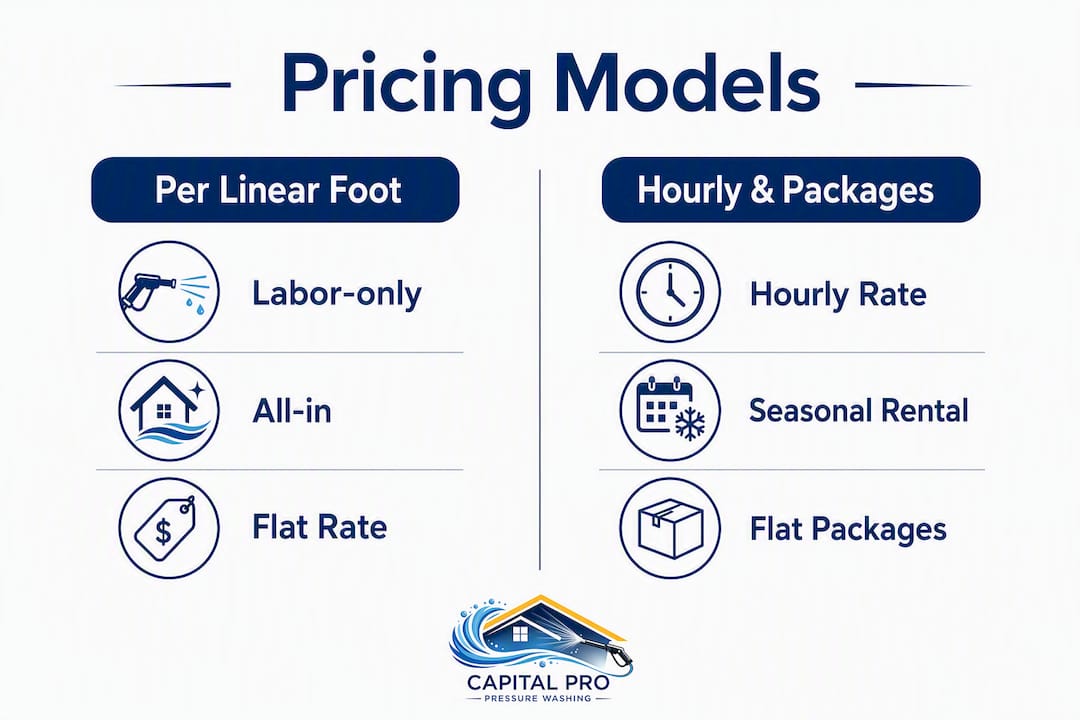
Per-linear-foot pricing is the most common model for rooflines and gutterlines. Industry pricing frameworks break it into three tiers: basic roofline work at $2.50–$5/ft, standard full-service at $5–$7/ft, and premium installs at $7–$12/ft. Hourly billing tends to appear when a job is hard to measure in advance, like a complex multi-level roofline or a large landscaping wrap.
Flat seasonal rental packages are worth knowing about. For $100–$400, some companies supply the lights, install them, and take them down at season’s end. You never touch a strand, and there’s nothing to store. Per-foot pricing on rental installs typically aligns with the $5–$10 range when you factor in the full-service value.
Sample estimates by home size
| Home Type | Est. Linear Feet | Labor-Only Cost | All-In Cost |
|---|---|---|---|
| Small single-story roofline | 80–120 ft | $160–$600 | $400–$1,440 |
| Medium two-story home | 150–200 ft | $300–$1,000 | $750–$2,400 |
| Large/custom display | 250–350 ft | $500–$1,750 | $1,250–$4,200 |
A 100-foot roofline at $4/ft labor-only = $400 in labor. Add $150 for retail lights and $100 for takedown, and you’re at $650 total. The same job all-in at $6/ft = $600, with commercial-grade lights and takedown often included. The all-in route frequently costs less than it looks.
What factors change your holiday lighting quote the most?
Several variables can push a quote up or down by hundreds of dollars. Here’s what actually moves the number:
- Type and quality of lights. Retail LED strings from a big-box store cost less upfront but degrade faster. Commercial-grade, weather-rated LEDs used by professional installers last longer and hold color better through a New York winter.
- Roofline linear footage and complexity. A simple ranch-style roofline is fast to run. A Victorian with multiple peaks, dormers, and valleys takes significantly more time and clips.
- Trees and shrubs. Wrapping a 20-foot tree is often priced as a flat per-piece rate rather than per foot, because the labor is intensive regardless of the strand length. One large tree can add $100–$300 to a quote.
- Height and access. Two-story and three-story homes require taller ladders, more setup time, and higher insurance exposure. Expect a surcharge for anything above a standard single-story roofline.
- Regional labor and insurance costs. Urban and high-cost-of-living areas consistently see higher per-foot rates because of wages, insurance premiums, and travel time. The same 150-foot roofline that costs $600 in a mid-size market might run $900 in a major metro.
- Add-ons. Smart timers, remote controls, and color-changing systems add both materials cost and programming time.
Labor typically accounts for up to 65% of total project cost. That means on a $700 job, roughly $455 is labor. Materials, clips, and hardware make up the rest. Understanding that split helps you evaluate whether a quote is reasonable or padded.
Pro Tip: Three practical ways to reduce cost: simplify the design to a single roofline run (skip the trees the first year), book in October before peak-season surcharges kick in, and ask whether the installer offers a multi-year discount if you commit to a second season.
What should a professional holiday lighting quote include?
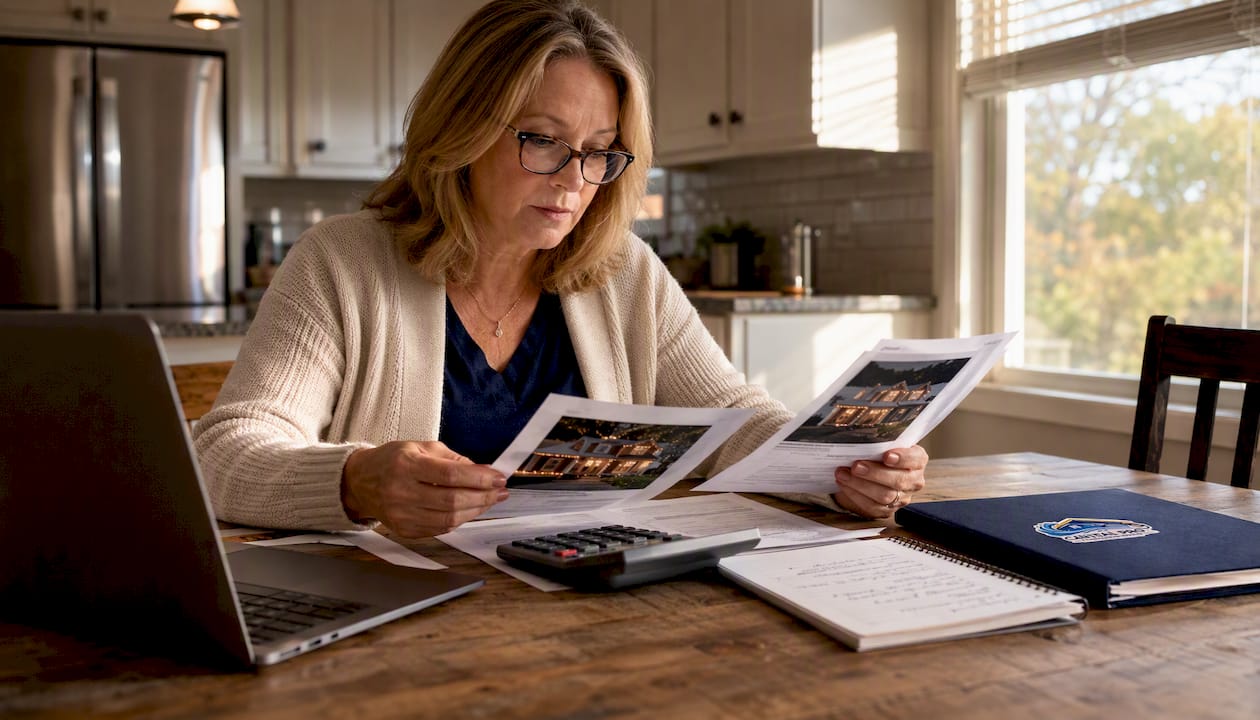
A trustworthy quote is itemized. If a bid arrives as a single lump sum with no line items, that’s a problem. Here’s what a solid quote typically covers:
Standard inclusions to expect:
- Custom measurement and design layout
- Commercial-grade, weather-rated LED strands (if installer-supplied)
- Mounting clips and fasteners appropriate to your roofline material
- Timer or smart-control setup
- In-season repair response (industry standard is 24–48 hours per professional installer standards)
- Post-season takedown
- Optional off-season storage
Common exclusions that trigger surprise charges:
- Electrical panel work or new outlet installation
- Emergency rehangs after storm damage (check whether this is covered)
- Storage fees, if not bundled into the package
- Mid-season service calls beyond a defined number of visits
Statistic check: With labor representing up to 65% of project cost, a quote where labor is vaguely described as “installation” with no breakdown is a red flag. Ask the installer to separate labor from materials so you can compare bids on equal terms.
Requesting a fully itemized quote that lists materials type, labor, takedown, storage, and repair response time is the single most reliable way to avoid mid-season surprise charges. When comparing bids, a cheaper number that excludes takedown, service calls, and storage can easily end up costing more than a higher all-in quote.
Removal-only services, if you need them separately, typically run $100–$400. Mid-season maintenance calls usually run $75–$150. Storage, when not bundled, adds $50–$300 per season.
Should you DIY or hire a pro?
The honest answer depends on your house, your schedule, and your risk tolerance.
DIY makes sense when:
- Your home is a single story with a simple, accessible roofline
- You already own or are willing to buy quality lights and proper mounting clips
- You have time to install, troubleshoot outages, and take everything down in January
- You’re comfortable on a ladder and have a spotter
Hiring a pro makes sense when:
- Your roofline is two stories or higher
- You want commercial-grade lights that look uniform and last multiple seasons
- You’d rather not deal with a strand going dark on December 22nd
- You want takedown handled without scheduling it yourself
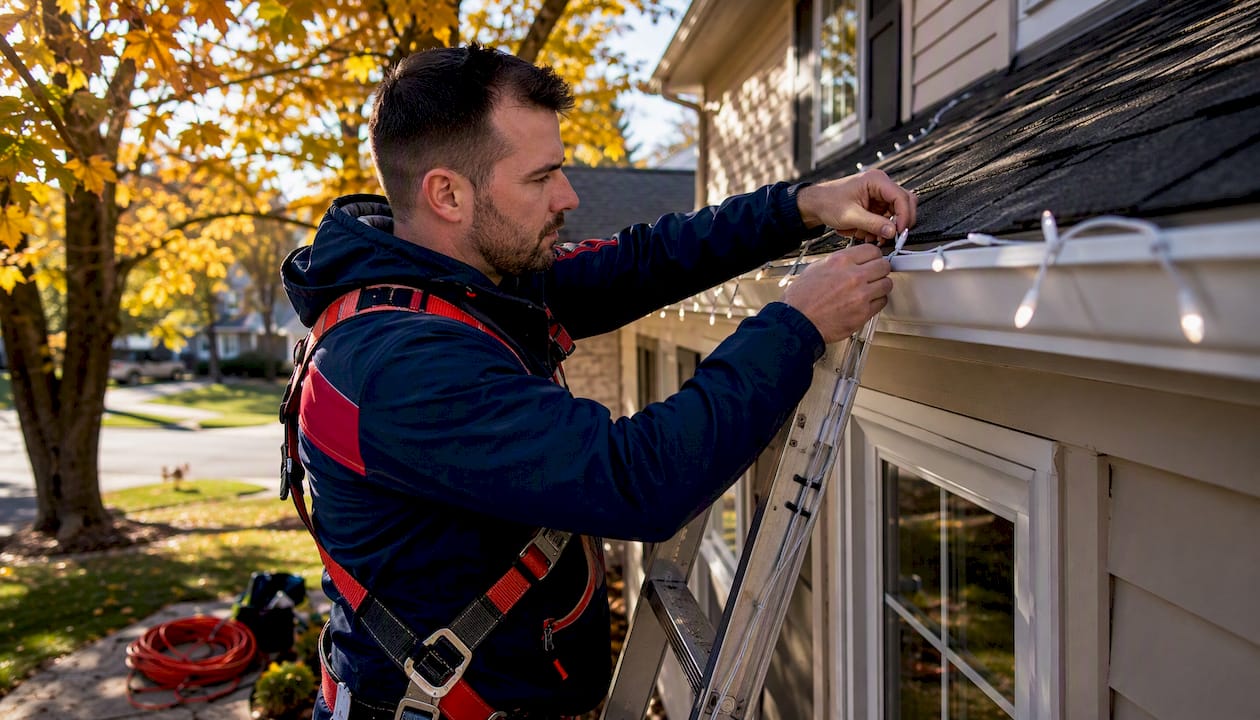
The safety case for hiring a pro is real: ladder falls are among the most common home-improvement injuries, and holiday light installs on steep or tall rooflines are exactly the scenario where that risk spikes.
Questions to ask prospective installers:
- Are you licensed and insured? (Ask for proof, not just a yes.)
- Do you carry liability insurance and workers’ comp?
- What’s your response time for in-season repairs?
- Does the quote include takedown and storage, or are those separate?
- What’s your deposit requirement, and what payment methods do you accept?
- Do you offer early-booking discounts or multi-year packages?
Red flags to watch for:
- A quote with no written scope of work
- No proof of insurance when asked
- A deposit demand above 50% before any work begins
- Vague answers about repair response time
- No mention of takedown in the quote
Early booking — typically in October — often secures 10–20% off compared to peak November/December pricing. Bundling multiple services (lights plus gutter cleaning, for example) can also unlock package discounts with some installers.
How to estimate your own holiday lighting cost
Use this worksheet before you call any installer. It takes about 10 minutes and gives you a realistic budget range.
Step 1: Measure your linear footage. Walk the perimeter of your roofline and measure the sections you want lit. Include gutterlines, peaks, and any architectural features. A standard single-story ranch might be 80–120 feet. A two-story colonial often runs 150–200 feet.
Step 2: Apply the formula.
Step 3: Run your numbers against these three scenarios.
| Scenario | Linear Feet | Labor-Only (@ $4/ft) | All-In (@ $7/ft) | Removal/Storage | Estimated Total |
|---|---|---|---|---|---|
| Small single-story | 100 ft | $400 | $700 | $150–$200 | $550–$900 |
| Medium two-story | 175 ft | $700 | $1,225 | $200–$300 | $900–$1,525 |
| Large/custom display | 300 ft | $1,200 | $2,100 | $300–$400 | $1,500–$2,500 |
First-year vs. repeat-year costs. The first season is almost always the most expensive. Professional installers use commercial-grade, weather-rated LED strands that are custom-cut to your roofline. Those materials are a one-time purchase. In year two, you’re paying primarily for labor, takedown, and storage — often 30–50% less than year one. A $900 first-year install might run $450–$600 in subsequent seasons.
Pro Tip: Book in October. Installers commonly add rush fees in November and December, and the best scheduling slots fill fast. An early booking can save you 10–20% and guarantee your preferred install date.
Permanent vs. seasonal installation: which makes more sense?
Permanent mounted lighting systems are a different category entirely. Instead of strands hung seasonally, these use track-mounted LED fixtures installed along rooflines and architectural features. They stay up year-round and can display any color or pattern via an app.
Upfront costs for permanent systems typically run $3,000–$6,000, with per-foot installed costs often in the $20–$40 range. That’s a significant investment compared to a $500–$900 seasonal install.
The break-even math works like this: if you’re spending $700–$900 per year on professional seasonal installs, a $4,000 permanent system pays for itself in roughly 4–6 years. Industry estimates put the break-even range at 3–8 years depending on coverage and local pricing. Capital Pro Pressure Washing also offers permanent outdoor lighting for homeowners in the Capital Region who want a year-round solution.
A few practical considerations before committing to permanent:
- HOA restrictions. Some homeowners associations restrict permanent exterior fixtures. Check your CC&Rs before purchasing.
- Permits. Depending on your municipality, permanent electrical fixtures may require a permit. Confirm with your local building department.
- Visibility year-round. Track systems are visible even when off. Most are designed to be low-profile, but it’s worth seeing an installed example before committing.
- Maintenance. Individual LEDs can fail and need replacement. Reputable installers include a warranty on the fixtures themselves.
For most homeowners who want lights only during the holiday season, seasonal professional installs remain the more practical choice. Permanent systems make the most sense for homeowners who also use them for other occasions (July 4th, birthdays, sports events) and want to eliminate the annual install cost entirely.
Key Takeaways
Professional holiday light installation averages around $442 nationally, with most jobs running between $220 and $685 per season; first-year costs are higher due to custom, commercial-grade materials.
| Point | Details |
|---|---|
| National cost range | Most jobs fall between $220 and $685, with a national average of $442 for professional installs. |
| Per-foot benchmarks | Labor-only is typically $2–$5 per foot; all-in (installer-supplied lights) is $5–$10 per foot. |
| First-year vs. repeat cost | First-year is highest; subsequent years typically cost 30–50% less once materials are in place. |
| Permanent systems | Upfront costs can be several thousand dollars with a break-even of several years versus annual pro installs. |
| Capital Pro Pressure Washing | Offers end-to-end holiday lighting in New York’s Capital Region, from design through takedown and storage. |
The case for not cutting corners on holiday lighting
The conventional wisdom says “get three quotes and pick the middle one.” That’s fine advice for replacing a water heater. For holiday lighting, it misses the point.
The real cost of a cheap install isn’t the price on the quote. It’s the strand that goes dark on December 15th, the installer who doesn’t answer the phone, and the lights still hanging from your gutters in February because takedown wasn’t included. Those aren’t hypotheticals — they’re the most common complaints homeowners have after hiring the lowest bidder.
What professional holiday lighting actually buys you is a system. Custom-measured commercial-grade strands that fit your roofline cleanly. A repair response window written into the contract. Takedown scheduled before the new year. Off-season storage so you’re not hunting for a bin in November. When you price it that way, the $700 all-in quote often beats the $400 labor-only quote by a wide margin.
The other thing most articles understate: ladder safety on a two-story roofline in October or November is a genuine hazard. Wet leaves, cold hands, and steep pitches are exactly the conditions where falls happen. That’s not a reason to avoid DIY on a single-story ranch. It is a reason to be honest about your setup before you decide.
Capital Pro Pressure Washing handles holiday lighting from start to finish
Skipping the annual ladder scramble is exactly what Capital Pro Pressure Washing is built for. As a veteran-owned company with over 10 years serving New York’s Capital Region, they handle the full scope: design consultation, commercial-grade LED installation, in-season repair response, post-season takedown, and storage options so nothing sits in your garage until next November.

For homeowners in Albany, Troy, Saratoga Springs, and surrounding areas, Capital Pro offers itemized quotes with no hidden fees. Booking early in the season typically secures better scheduling and pricing. Whether you’re lighting a single-story roofline or a larger property with trees and architectural features, the process starts with a straightforward quote.
Request a holiday lighting quote from Capital Pro Pressure Washing and get a line-item estimate before the October rush.
Useful sources
These are the primary sources used to build this guide. Each link points to the original data or framework referenced in the article.
- Christmas Light Installation Pricing — LightQuoter — Early-booking discounts (10–20%), peak-season surcharges, per-element pricing for trees and shrubs.
- How to Bid Christmas Light Installation — Jobber — Industry benchmark confirmation of $442 national average; material cost estimation framework.
- U.S. Consumer Product Safety Commission — cpsc.gov — Safety standards for holiday lighting products and ladder safety context.
FAQ
What is the average cost to have Christmas lights installed?
The national average for professional Christmas light installation is around $442, with most residential jobs falling between $220 and $685, depending on home size, light type, and whether the installer supplies the lights.
How much does it cost to install 200 feet of Christmas lights?
At labor-only rates of $2–$5 per foot, a 200-foot run would cost $400–$1,000; at all-in rates of $5–$10 per foot, expect $1,000–$2,000, with removal and storage potentially adding $100–$400 on top.
How do installers typically charge for Christmas light installation?
Most installers price by the linear foot (labor-only at $2–$5/ft or all-in at $5–$10/ft), though some use hourly crew rates for complex jobs or offer flat seasonal packages. Per-foot pricing is the most common model for standard rooflines.
How much does permanent holiday lighting installation cost?
Permanent mounted LED systems typically cost $3,000–$6,000 upfront, with per-foot installed costs often in the $20–$40 range. Capital Pro Pressure Washing offers permanent outdoor lighting in the Capital Region for homeowners who want a year-round solution.
What should I confirm before hiring a holiday light installer?
Ask for proof of liability insurance and workers’ comp, a written itemized quote that includes takedown and storage, and a defined repair response time for in-season issues. Warranty terms and service guarantees are among the most important factors to confirm before signing any contract.
Recommended
Services Related To This Article
Need a quote in the Capital Region?
Fast, free estimates from a local, licensed & insured team.
