
Siding Oxidation Removal: A DIY Soft-Wash Guide
Yes, you can usually remove or dramatically reduce oxidation on siding with a controlled soft-wash. A soft-wash treatment using an oxidation-specific cleaner lifts most of that chalky, faded film in an afternoon. Severe, long-term photo-oxidation is another story: once UV exposure has broken down the pigment layer itself, no cleaner brings back the original color, and you’re looking at repainting or replacement instead.
Before you buy anything, run the wipe test. Rub a dry, gloved finger across a small section of siding. A chalky, color-matched residue means oxidation. A slick or sticky film usually means mildew or organic buildup, which calls for a different approach entirely.
- Wipe test a shaded and a sun-exposed section to compare severity.
- Test your chosen cleaner on a hidden patch and wait 24 hours before treating the whole wall.
- Use a soft-wash sprayer at low pressure, never a pressure washer nozzle.
- Call a professional if the wipe test reveals deep chalking, brittleness, or bare substrate showing through.
Pro Tip: Chalk that transfers heavily onto a white paper towel after one light wipe is a sign the oxidation has progressed past a simple surface cleaning. Photograph it before you start treatment so you have a baseline for comparison.
Key Takeaways
Soft-wash cleaning with an oxidation-specific product removes most chalky buildup, but severe UV-driven pigment breakdown often requires repainting or siding replacement instead.
| Point | Details |
|---|---|
| Run the wipe test first | A chalky smear means oxidation; a slick film means mildew, and each needs a different cleaner. |
| Soft-wash beats pressure washing | Low pressure plus the right chemical dwell time removes chalking without etching or streaking panels. |
| Choose the cleaner by severity | Oxygen bleach suits light chalking; Ox-Knox Brushless Oxidation Remover or Renu Universal House Wash handle heavier buildup. |
| Know the limits of cleaning | Once the oxidized shell erodes past the pigment layer, only repainting or replacement restores full color. |
| Call a pro for deep chalking | Capital Pro Pressure Washing runs a test-patch soft-wash process and pairs cleaning with sealing for longer-lasting results. |
Table of Contents
- How Do You Safely Remove Oxidation From Siding Yourself?
- Which Cleaners Actually Remove Oxidation From Siding?
- What Mistakes Make Siding Oxidation Worse?
- When Should You Call a Professional for Oxidized Siding?
- How Do You Keep Siding From Oxidizing Again?
- Why Does Oxidation Happen, and Why Does It Come Back?
- Get Your Siding Professionally Restored
- Sources
- FAQ
How Do You Safely Remove Oxidation From Siding Yourself?
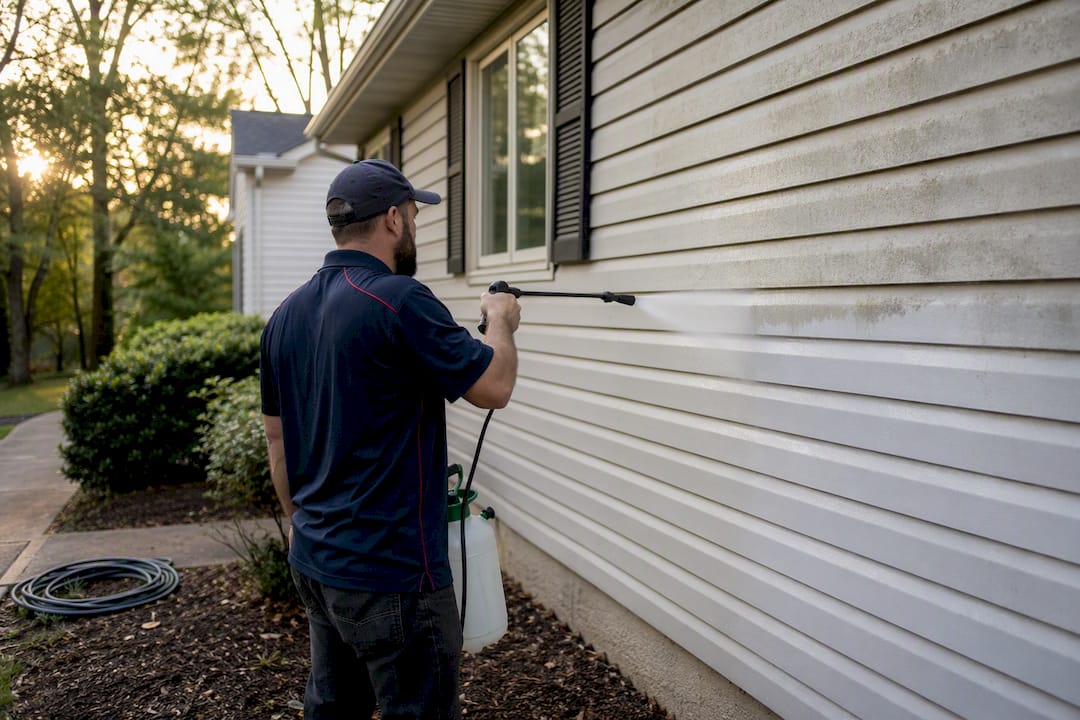
The safest DIY method is a soft-wash: chemistry does the work, not water pressure. Start with the wipe test on three or four spots around the house, including a north-facing wall and a sun-baked south wall, since oxidation severity often varies by exposure. A light, even chalky smear means you’re dealing with standard oxidation, not mold or dirt film, and can proceed with a cleaner-based approach.
What you’ll need:
- An oxygen bleach cleaner or a soft-wash sodium hypochlorite mix
- A pump-up soft-wash sprayer or a low-pressure attachment (never a zero-degree pressure tip)
- A garden hose with a fan nozzle for rinsing
- A soft-bristle brush for stubborn spots (used sparingly)
- Gloves, eye protection, and old clothes since bleach-based cleaners will splash
The process:
- Pre-wet any nearby plants and grass with plain water to protect them from runoff.
- Mix your cleaner per label instructions. Soft-wash operators typically run sodium hypochlorite around 1 to 3 percent on-surface concentration mixed with a surfactant so the solution clings to vertical surfaces instead of sheeting off immediately.
- Test a two-foot patch in an inconspicuous area. Wait 24 hours and check for discoloration or streaking before treating the full wall.
- Apply from the bottom up in overlapping passes, letting the cleaner dwell for 5 to 10 minutes. Applying bottom to top prevents the solution from streaking down onto dry, unrinsed sections.
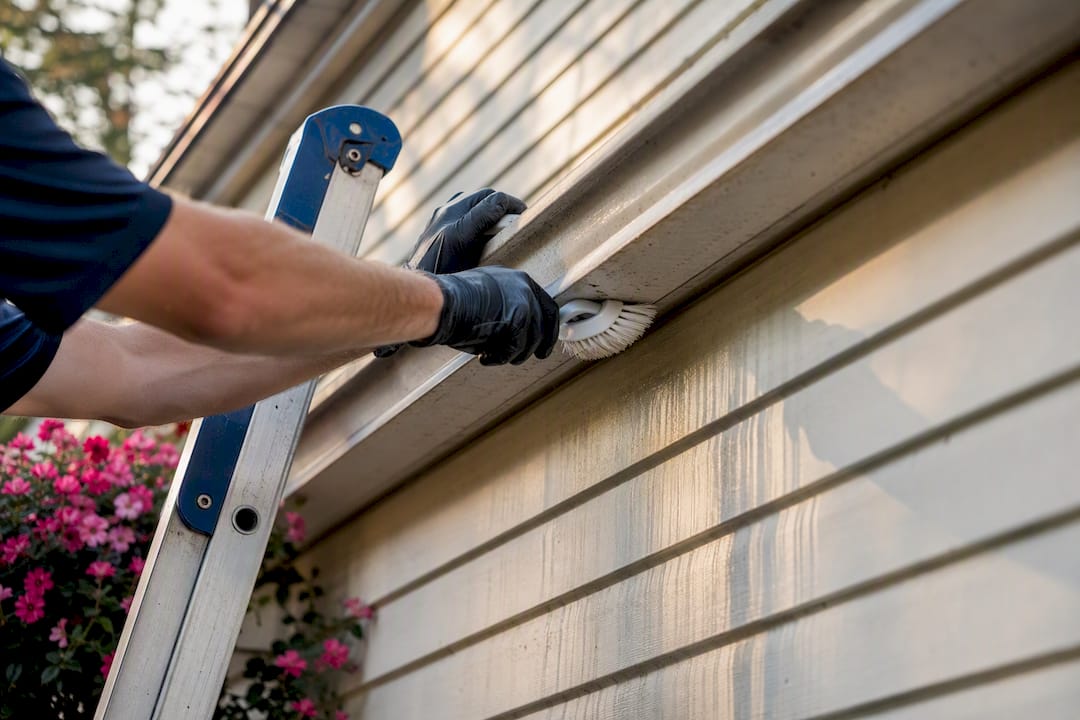
- Agitate only where chalking is heavy, using the soft brush in gentle circular motions. Skip agitation everywhere else.
- Rinse top-down at low pressure, keeping the nozzle 12 to 18 inches from the surface and moving steadily so you don’t create clean spots next to still-dirty ones.
- Rinse all landscaping again with plain water to neutralize any bleach residue.
Keep your dwell time and rinse technique consistent across the entire wall. Uneven timing is the single biggest cause of zebra striping, where some panels come out brighter than their neighbors. Never angle the nozzle upward to force water under the siding laps; that drives moisture behind the panels and invites rot.
Pro Tip: Work in the shade or on an overcast day. Direct sun dries cleaner on the surface before it finishes breaking down the oxidized layer, which leaves patchy results no amount of rinsing will fix.
Which Cleaners Actually Remove Oxidation From Siding?
Not every cleaner attacks oxidation the same way. Oxygen-based cleaners work through mild chemical action and suit light, early-stage chalking on vinyl. Soft-wash sodium hypochlorite blends handle organic growth alongside oxidation lift, which makes them the go-to for siding that has both mildew staining and chalk. Specialty brushless oxidation removers use stronger surfactant chemistry designed specifically to dissolve heavier, years-old chalking without any scrubbing.
Two products come up repeatedly among homeowners tackling this problem:
- Ox-Knox Brushless Oxidation Remover is formulated for vinyl, fiber cement, and other exterior surfaces with heavy chalking, and it’s designed to work without aggressive scrubbing.
- Renu Universal House Wash is sold as a concentrated exterior cleaner that lists oxidation removal among its main uses, and it dilutes for broader house-wash applications beyond just siding.
Both require you to follow label dilution ratios and wear the PPE the manufacturer specifies. Before choosing, weigh your siding material (vinyl tolerates more aggressive chemistry than fiber cement), the color and age of the panels, how heavy the chalking is, and whether you have plants close enough to need extra rinsing.
What Mistakes Make Siding Oxidation Worse?
The fastest way to ruin oxidized siding is to reach for a pressure washer instead of a soft-wash setup. High pressure blasts through the chalky layer unevenly, exposing patches of weaker material underneath and leaving permanent streaks.
- Using a pressure washer or narrow-angle nozzle directly on oxidized panels
- Spot-cleaning one section aggressively instead of treating the whole wall evenly
- Letting cleaner dry on the surface before rinsing
- Mixing cleaner too strong, guessing instead of measuring
- Angling the spray upward, which forces water behind the laps
A single misjudged pass with a pressure washer can convert a straightforward oxidation cleaning into a costly repair. Operators who mistake oxidation for ordinary dirt often strip away the oxidized shell unevenly, leaving blotches that no amount of rinsing corrects.
Avoid each mistake by keeping dwell time identical across every panel, agitating only lightly, holding a constant nozzle distance, and following the product label instead of eyeballing the mix.
When Should You Call a Professional for Oxidized Siding?
Call a pro when the wipe test shows deep, persistent chalking that doesn’t lighten after a light rub, when panels feel brittle or flex oddly, or when color loss looks patchy across the whole house rather than isolated to one sun-exposed wall.
What a professional does differently:
- Runs a controlled soft-wash system with metered chemical ratios instead of a garden-hose guess.
- Applies commercial-grade oxidation removers and, where appropriate, a UV-resistant sealer afterward.
- Tests a patch first and documents the result before committing to the whole house.
- Uses low-pressure agitation only where hand-testing shows it’s actually needed.
Cost depends on home size, how severe the chalking is, roofline height and accessibility, and whether you add sealing or paint-prep work afterward. Expect pricing to vary by region and job scope; a house washing service can walk you through a quote after seeing your siding in person.
Before booking anyone, ask about insurance, soft-wash experience specifically (not just general power washing), their test-patch policy, and whether they guarantee against streaking or damage.
How Do You Keep Siding From Oxidizing Again?
Most homes hold results well with an annual soft-wash; homes in high-UV climates or near salt air often need it twice a year to stay ahead of buildup.
- Trim shrubs and trees back from siding to improve airflow and drying time
- Clean gutters and check drip lines above windows and doors, since overflow streaks accelerate localized weathering
- Consider a UV-resistant sealant on fiber cement or painted siding
- Skip abrasive scrub pads or stiff brushes on future cleanings
Track your progress with a quick annual wipe test on the same wall each year. If chalking returns faster than it did previously, that’s a signal your siding’s protective additives are wearing thin faster than average.
Pro Tip: Bundle your siding wash with gutter cleaning or window cleaning on the same visit. Overflow stains and dirty gutters accelerate localized oxidation right below the roofline, so treating them together stretches the life of your last cleaning. For a broader seasonal routine, a spring maintenance checklist helps you time these tasks around the rest of your home’s upkeep.
Why Does Oxidation Happen, and Why Does It Come Back?
Oxidation is UV light breaking down the polymer binders and pigments in your siding’s surface layer. That breakdown produces the chalky residue you’re wiping off, and NIST’s weathering research shows this process forms distinct layers: an oxidized shell, a colored middle layer, and an undegraded core underneath.
Cleaning removes the loose chalk, but it can’t rebuild the binder structure that UV already destroyed. Additives like titanium dioxide and calcium carbonate affect how fast that shell forms and how it weathers over time, which is why two houses of the same age can chalk at very different rates.
- Cleaning restores appearance by removing loose surface chalk.
- It can’t restore pigment depth once the shell itself has eroded.
- Recurrence is normal; oxidation is an ongoing weathering process, not a one-time defect.
A note from the field
Most oxidation calls we get fall into one of two categories: light chalking that a single soft-wash clears up completely, or years-of-neglect chalking where a test patch tells the real story before we commit to the whole house. We always test first.
Get Your Siding Professionally Restored
Capital Pro Pressure Washing gets you the soft-wash result described above without the trial-and-error of dialing in your own chemical mix, sprayer pressure, and dwell time on your own siding. We run a controlled soft-wash process built specifically for oxidized vinyl and fiber cement, always starting with a small test patch so you see the result before we commit to the full house.

Our house washing service covers oxidation removal, organic staining, and a written scope so you know exactly what’s included before work starts. If you’re in the Capital Region and your siding’s wipe test came back chalky, request a quote and ask us for a test patch on your first visit. We’ll tell you honestly if soft-wash cleaning will get your siding looking right again, or if you’re better served pairing the wash with a sealing treatment for lasting results.
Sources
- Effects of Weathering and Formulation on the Properties of Vinyl Siding
- How to Tell Oxidation vs Dirt on Siding and Why It Changes How You Clean (InspectApedia excerpt)
- Pressure Washing Vinyl Siding: Complete Operator Guide · MakeWash
FAQ
Can oxidized vinyl siding be rejuvenated?
Yes, in most cases a soft-wash with an oxidation-specific cleaner restores much of the original appearance. If the wipe test shows deep, persistent chalking or brittle panels, cleaning alone likely won’t fully rejuvenate it, and repainting or replacement becomes the more realistic fix.
What is the best product to remove oxidation from vinyl siding?
Ox-Knox Brushless Oxidation Remover and Renu Universal House Wash are both formulated specifically for oxidation, with Ox-Knox suited to heavier chalking and Renu working well as a broader house-wash cleaner. A soft-wash sodium hypochlorite blend also lifts oxidation effectively when organic staining is present too.
Does white vinegar remove oxidation from siding?
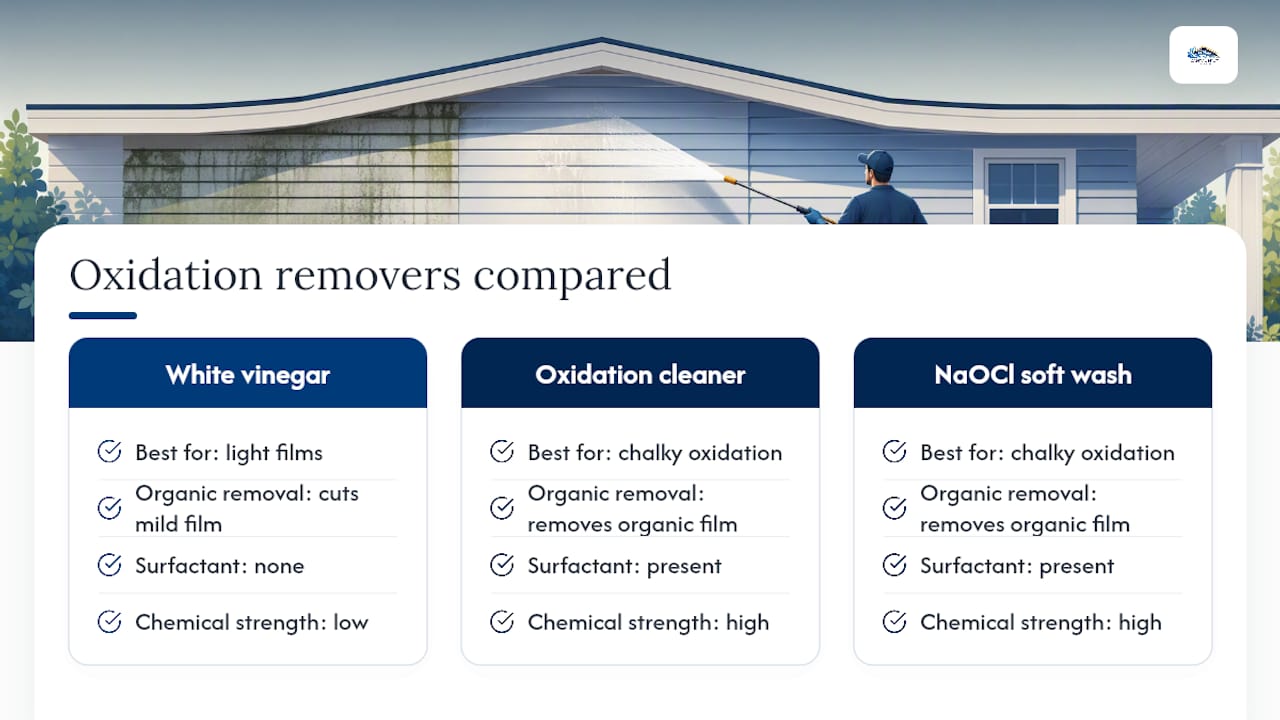
Vinegar can cut through light dust and mild organic film, but it lacks the surfactant and chemical strength that oxidation-specific cleaners or soft-wash sodium hypochlorite blends provide. It’s not a reliable fix for actual chalky oxidation.
What does oxidation look like on vinyl siding?
Oxidation shows up as a dull, faded, chalky film that leaves a powdery, color-matched residue when you rub it with a dry cloth or finger. It’s most visible on sun-facing walls and darker-colored siding, where UV breakdown happens fastest.
Recommended
Services Related To This Article
Need a quote in the Capital Region?
Fast, free estimates from a local, licensed & insured team.
