
Kill Algae in 10–15 Minutes With Soft Wash Pool Deck Cleaning
Most pool decks need a surface-appropriate soft wash or a low-pressure surface cleaner, not a full-blast pressure washer. Save higher-pressure equipment for hard poured concrete only, and always direct runoff away from the pool before you rinse anything. If your deck is natural stone, has heavy algae buildup, or the job is large, call a professional instead of risking the surface or your pool water.
Quick Summary:
- Soft washing with diluted bleach solutions effectively cleans algae and organic stains on most pool deck surfaces without causing damage.
- Pressure washing is suitable only for bare poured concrete and must be done at moderate PSI with proper techniques to avoid etching or surface degradation.
- Natural stone, pavers, and sealed surfaces require gentle methods like soft washing because high pressure or acidic cleaners can damage their porous or coated finishes.
- Proper runoff control using drains or absorbent barriers is essential to prevent pool water contamination and comply with local disposal regulations.
- Regular maintenance includes light spot cleaning monthly, deep cleaning annually, and sealing after each deep clean to maintain slip resistance and appearance.
Table of Contents
- What Kind Of Pool Deck Cleaning Does Your Surface Need?
- How Do You Clean A Pool Deck Step By Step?
- How Do You Keep Cleaning Runoff Out Of The Pool?
- When Should You Hire A Professional For Pool Deck Cleaning?
- How Often Should You Clean And Seal A Pool Deck?
- Why Soft Wash Should Be Your Default, Not Your Backup
- Get Your Pool Deck Professionally Restored
- Sources
- FAQ
What Kind Of Pool Deck Cleaning Does Your Surface Need?
Before you touch a hose or a chemical bottle, figure out what you’re actually standing on. Deck materials react very differently to pressure and chemicals, and guessing wrong is how homeowners end up with etched concrete or a paver patio that never sits flat again.
- Plain or stamped concrete: Durable enough for moderate pressure washing, but stamped or colored concrete has a coating that can peel or fade under aggressive pressure. Soft wash first; reserve higher PSI for bare gray concrete only.
- Exposed aggregate: The pebbled surface hides algae in its texture. A rotating surface cleaner works better here than a wand, which tends to leave visible lines.
- Pavers: Cleaning pavers is safe at moderate settings, but blasting the joints washes out the polymeric sand that holds them in place, opening the door to weeds and shifting.
- Travertine and natural stone: These are porous and can etch, pit, or discolor under high pressure or acidic cleaners. Soft wash almost always, and test any product in a hidden corner first.
- Wood decking: Splinters and raised grain result from pressure that’s too high or held too close. Low pressure with a wide fan tip, always moving.
- Composite decking: Resistant to rot but easily scarred by concentrated pressure streams, which leave permanent striping in the surface.
- Sealed or coated surfaces: Any deck with an existing sealant needs the gentlest method available, since aggressive cleaning strips the coating along with the dirt.
Getting this identification right matters because the damage from the wrong method rarely shows up immediately. Soft wash methods and calibrated PSI ranges exist specifically because contractors have seen what happens when a homeowner treats a travertine patio like a concrete driveway.
How Do You Clean A Pool Deck Step By Step?
Once you know your surface, the actual cleaning follows a fairly consistent sequence, whether you’re doing it yourself or watching a contractor work.
- Prep the space. Move furniture and planters, sweep off loose debris, and cover pool skimmers and equipment. Test any cleaner or pressure setting on a small, inconspicuous patch first.
- Apply a soft wash where the surface calls for it. A diluted sodium hypochlorite mix (roughly a 1:3 to 1:5 ratio with water, depending on staining) breaks down algae on concrete and pavers. For pet areas or anyone wary of chlorine, an oxygen-bleach solution works nearly as well with less residue. Let it dwell 10 to 15 minutes, but don’t let it dry on the surface.
- Use a surface cleaner for even coverage on flat concrete or aggregate. clean faster than a wand and avoid the overlapping streak marks a handheld wand almost always leaves behind.
- Pressure wash only where the material can take it; for professional options and techniques, see Professional Pressure Washing & Driveway Cleaning in London. On bare poured concrete, pressure washers at an appropriately high but controlled PSI with the correct nozzle and technique clean effectively without etching. Anything softer than concrete should stay under soft-wash territory.
- Treat stubborn stains separately. A Dawn dish soap and water mix lifts oil and sunscreen residue. Oxygen bleach handles organic staining like leaf tannins. White vinegar cuts light mineral scale, but skip it on natural stone since the acid can etch calcium-based surfaces.
- Work in sections, moving toward drains or the deck’s low point, never toward the pool itself.
Pro Tip: Clean on an overcast day rather than in direct sun. Cleaners evaporate fast in full sunlight, which cuts dwell time short and leaves algae only half-treated.
How Do You Keep Cleaning Runoff Out Of The Pool?
Pool chemistry is easy to throw off with a garden hose and a bottle of bleach, so runoff control isn’t optional. Work toward the deck’s perimeter drains whenever your layout allows it, and use absorbent booms or a simple berm of towels to redirect wash water away from the coping edge. Cover the skimmer basket before you start, and keep hoses and cleaning wands pointed away from the water at all times.
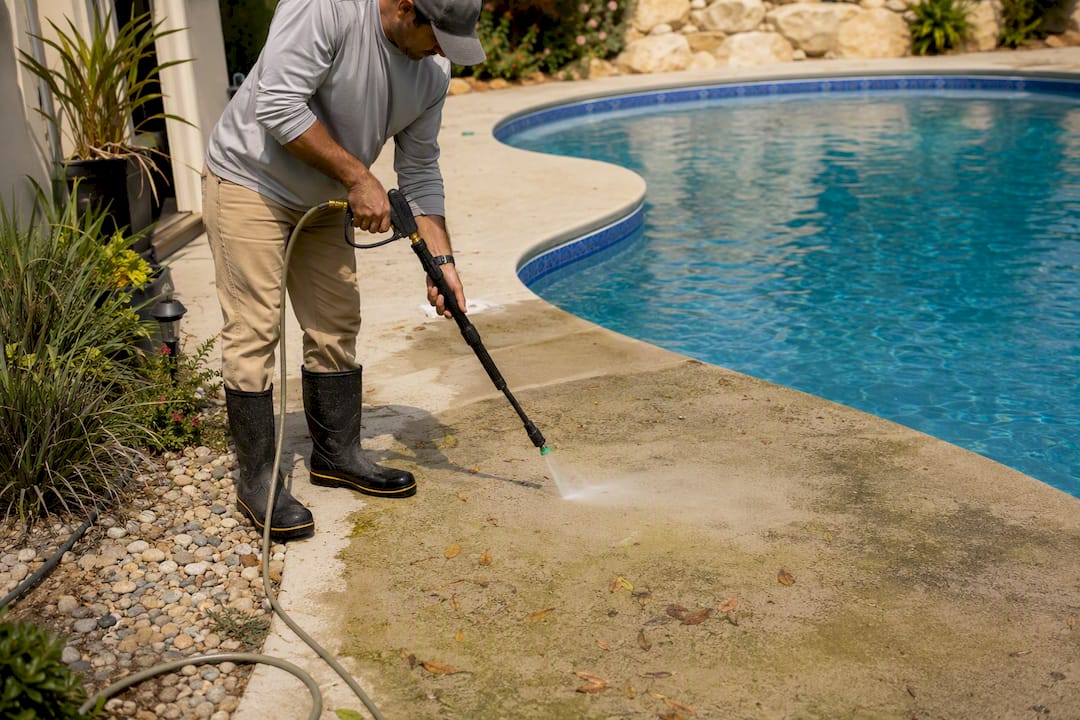
Chlorine-based cleaners generally don’t need separate neutralization since they match the pool’s own sanitizer, but acidic products like muriatic acid or vinegar should be diluted and rinsed thoroughly before anyone swims. As a general rule, wait at least an hour after your final rinse before reopening the pool.
Directing rinse water toward drains instead of the pool also matters for a reason beyond your own water chemistry: concentrated cleaning runoff shouldn’t go into storm drains, since many municipalities restrict that kind of discharge.
- Test pH and chlorine levels after cleaning, especially if any runoff reached the water.
- Cloudy water usually clears within a few hours; if it doesn’t, a shock treatment resolves it.
- Skim any visible cleaner residue off the surface before it settles.
Algae and mildew aren’t just cosmetic. Biofilm buildup on pool decks creates a slip hazard that’s often worse right at the pool’s edge, exactly where bare, wet feet are walking.
When Should You Hire A Professional For Pool Deck Cleaning?
Some jobs are worth doing yourself. Others aren’t, and knowing the difference saves both money and heartache.
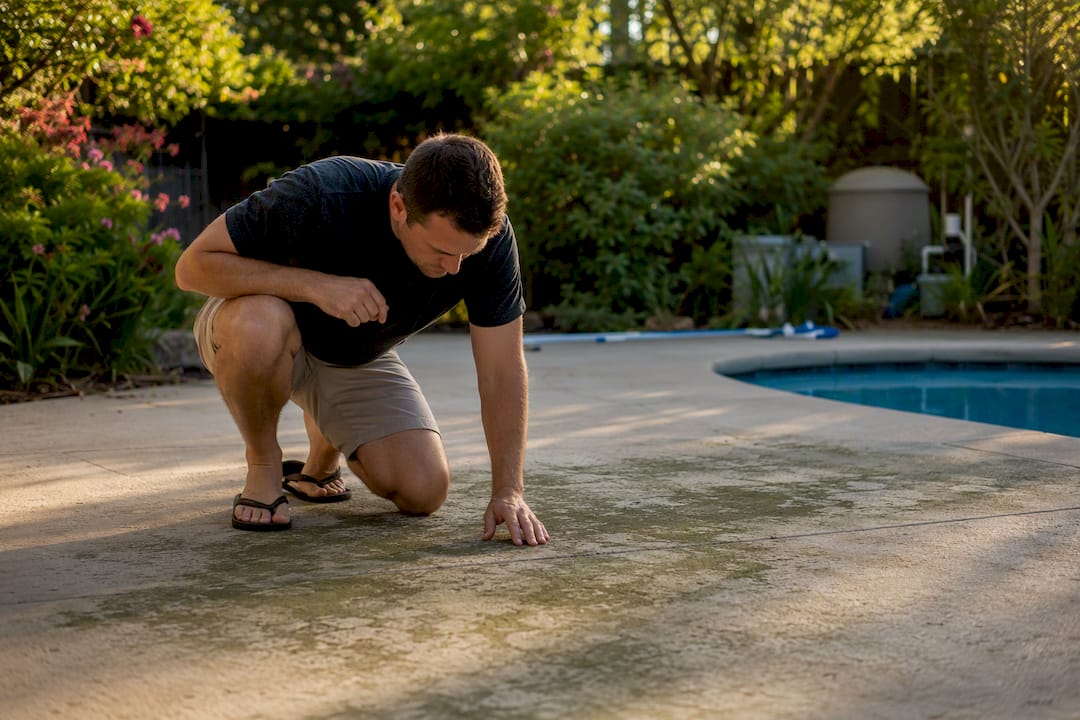
Call in a professional when you’re dealing with delicate natural stone, algae that’s built up over multiple seasons, extensive paver joint damage, landscaping close enough to the work area to be at risk, or any concern about where runoff will end up. Large decks also change the math: what takes a homeowner a full weekend takes an experienced crew a few hours, with more consistent results.
A professional pool deck cleaning typically follows this sequence:
- Pre-inspection to identify the surface, existing damage, and sensitive areas nearby.
- Calibrated PSI and nozzle selection matched to that specific material.
- Soft wash or surface-cleaner application, followed by full neutralization and rinse.
- Joint sand replacement on pavers, since skipping this step is one of the most common reasons DIY paver jobs look great for a month and then fall apart.
- A sealing application once the surface has fully dried.
Capital Pro Pressure Washing has spent more than a decade in New York’s Capital Region built specifically around this kind of surface-specific soft-wash work, as a veteran-owned company focused on protecting finishes rather than just blasting them clean. Expect a timeline that runs from same-day assessment through cleaning and a drying window before any sealer goes down.
Pro Tip: Ask any contractor what PSI range they plan to use on your specific surface. A vague answer is a red flag; a specific number tells you they’ve actually assessed the material.
How Often Should You Clean And Seal A Pool Deck?
A pool deck that gets a quick rinse after heavy use rarely needs the aggressive deep clean that a neglected one does. Build a simple rhythm around your climate and how much shade the deck gets.
- Rinse with a hose after parties or heavy pool days to knock off sunscreen and food residue before it sets.
- Light cleaning monthly during swim season, especially on high-traffic areas.
- A full deep clean once a year for most decks, twice a year if yours sits under trees or gets heavy leaf drop.
- Reseal after any deep clean once the surface is completely dry, since regular sealing significantly cuts down on re-soiling between cleanings.
Sealers fall into two categories. Penetrating sealers soak into the material and leave the surface texture unchanged, which is usually the better choice for slip resistance around a pool. Film-forming sealers sit on top and add a glossy look but can make wet surfaces slicker, so use them carefully near water.
| Task | Frequency | Why it matters |
|---|---|---|
| Hose rinse | After heavy use | Removes surface residue before it sets |
| Light cleaning | Monthly in season | Prevents algae from establishing |
| Deep clean | Annually (twice for shaded decks) | Removes embedded biofilm and stains |
| Reseal | After each deep clean | Restores stain and slip protection |
| Joint sand top-off | As needed on pavers | Prevents shifting and weed growth |
For seasonal prep, trim back overhanging branches before spring opening, add entry mats at pool gates, and spot-clean spills the day they happen rather than letting them set. A paver-specific restoration and sealing service handles joint sand replenishment as part of the job, which is worth knowing if your deck is paver-based and due for a refresh.
Why Soft Wash Should Be Your Default, Not Your Backup
Most advice on this topic treats pressure washing as the serious option and soft washing as the gentle alternative for people who are being overly cautious. That framing is backwards. Soft washing isn’t a compromise. On stamped concrete, pavers, and natural stone, it’s the method that actually gets the job done right, because it kills the algae at the root instead of just blasting the surface layer off and leaving the rest to regrow within weeks.
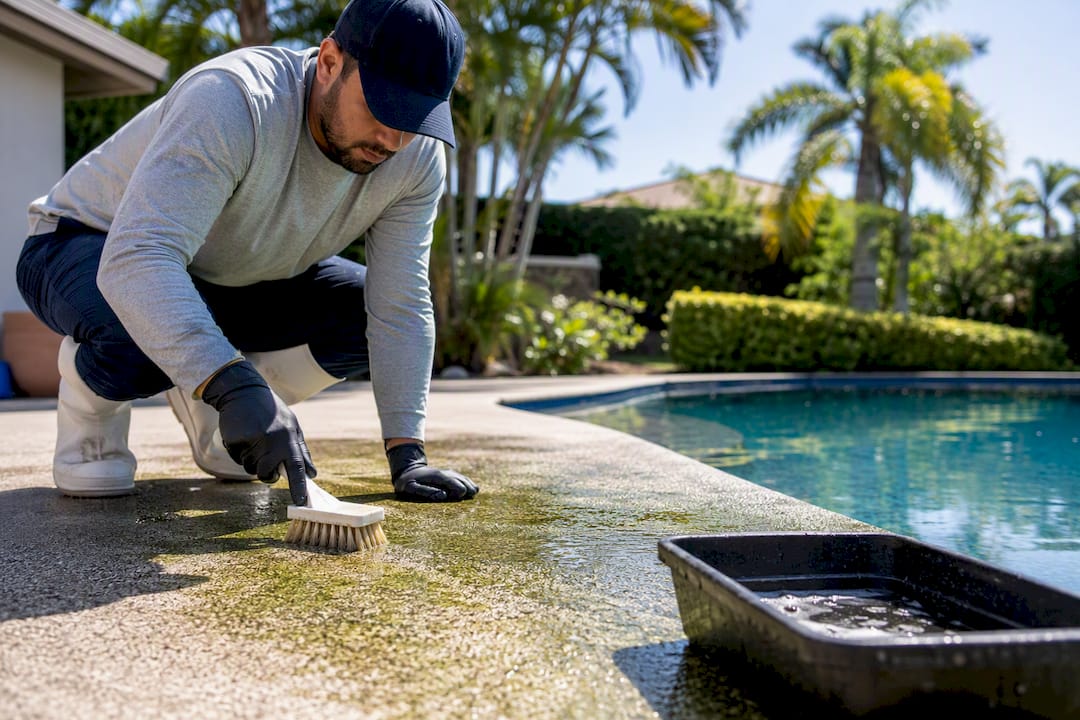
The conventional wisdom oversells pressure as a universal fix. Pressure washing has its place on bare poured concrete, but it’s a narrow one. The bigger mistake homeowners make isn’t picking the wrong PSI. It’s skipping the runoff plan entirely and assuming a hose and a bottle of bleach is a complete strategy.
If there’s one thing worth prioritizing first, it’s identifying your surface honestly before you pick up any equipment. Everything else, the chemical dilution, the pressure setting, the sealing schedule, follows from getting that first call right.
— Luis T
Get Your Pool Deck Professionally Restored
If you’ve read this far and you’re staring at a stamped concrete patio or a paver deck that’s seen ten summers of pool parties, you already know the stakes of getting the method wrong. Capital Pro Pressure Washing built its process around exactly this problem: calibrated soft-wash cleaning that removes algae and mildew without stripping color coatings, etching stone, or washing out paver joints, then backs it up with sealing so the deck stays cleaner longer.

That combination, cleaning plus sealing in the same visit, is what separates a deck that looks good for a week from one that stays slip-resistant and stain-free through the next full pool season. If your deck falls into the categories where DIY gets risky (natural stone, heavy biofilm, extensive paver work, or a large surface area), the deck and patio cleaning service covers the full process from pre-inspection through sealing. Request a quote and get a specific plan for your surface, not a generic pressure-washing package.
Sources
- Pool Deck Cleaning: How to Keep Your Outdoor Oasis Safe and Mold-Free - NOVA Exterior Cleaning
- How to Clean Pool Decking: 2026 Expert Guide & Reviews - Motor For Nerd
FAQ
What Is The Best Way To Clean A Pool Deck?
For most surfaces, a soft wash with diluted sodium hypochlorite or oxygen bleach, followed by a thorough rinse away from the pool, cleans effectively without risking damage. Use pressure washing mainly for bare, uncoated poured concrete where the surface can tolerate mechanical cleaning.
Can You Pressure Wash A Pool Deck?
Yes, but only on durable surfaces like plain poured concrete, and even then at moderate PSI with a wide nozzle angle. Pavers, natural stone, stamped concrete, wood, and composite decking are all better suited to soft washing or low-pressure surface cleaners.
What Kills Algae On A Pool Deck?
Diluted sodium hypochlorite or oxygen bleach, applied with a 10 to 15 minute dwell time and mechanical agitation, breaks down algae and mildew effectively. Heavier mineral or organic staining sometimes needs a follow-up with an acid-based cleaner, applied carefully and only on surfaces that can tolerate it.
What Is The Best Cleaner For Pool Deck Concrete?
A diluted sodium hypochlorite solution handles organic growth on plain concrete well, while oxygen bleach is a gentler option for anyone concerned about chlorine runoff near landscaping or pets. Muriatic acid can address mineral deposits and efflorescence but requires careful dilution, ventilation, and patch testing first.
When Should I Reseal My Pool Deck After Cleaning?
Reseal once the deck has fully dried after a deep clean, typically within a day or two depending on weather. Penetrating sealers work best for maintaining slip resistance right at the pool’s edge.
Recommended
Services Related To This Article
Need a quote in the Capital Region?
Fast, free estimates from a local, licensed & insured team.
