
How to Get Oil Stains Out of a Driveway, Fast
If the spill just happened, soak it up with clay cat litter, then degrease and scrub. If it’s already set or old, the method depends on your surface: alkaline degreaser and agitation for set stains, a poultice for oil embedded deep in concrete. Fresh spills usually come out completely; older, embedded stains typically require multiple treatment cycles before they fade to an acceptable level.
Quick Summary:
- Prompt absorption within the first hour is crucial to prevent oil from penetrating deeply into concrete’s pores, making removal easier later.
- Old or embedded stains often require multiple treatments with specialized poultices or alkaline degreasers, as surface cleaning alone is ineffective.
- Using a pressure washer before chemical treatment can worsen oil penetration, so it should be reserved for after degreasing in the cleaning process.
- Owner-applied methods are suitable for fresh and set stains but are unlikely to fully eliminate decades-old or deeply penetrated oil on asphalt.
- Professional cleaning and sealing are recommended for large, old, or embedded stains to prevent damage to asphalt and ensure complete oil removal.
Table of Contents
- How Do You Remove Oil Stains From a Driveway Right Away?
- Why Surface Type and Stain Age Change the Method
- Getting Oil Out of a Fresh Spill Before It Sets
- What Removes a Set Oil Stain That Won’t Budge?
- How to Poultice an Old, Embedded Oil Stain
- When Should You Call a Professional Instead?
- What Do Professionals Actually Do Differently?
- The Real Lesson Buried in Every Oil Stain
- Get Your Driveway Professionally Cleaned and Sealed
- Sources
- FAQ
How Do You Remove Oil Stains From a Driveway Right Away?
The first hour after a spill decides how much work you’ll do later. Oil that sits on the surface for even a day starts migrating into concrete’s pores, and every day after that makes extraction harder.
- Absorb. Pour clay cat litter, oil-dry, or plain sawdust over the spill and press it in with your shoe. Leave it at least 30 minutes for small drips and longer, such as overnight. For a larger spill like a puddle from a dead transmission line,
- Contain. Sweep or scoop the saturated absorbent into a sealed trash bag. Never hose it toward a storm drain. Most municipalities consider improper disposal of petroleum-soaked absorbents to be illegal.
- Degrease. Apply a few drops of Dawn dish soap or a concrete-safe degreaser directly on the residue and scrub with a stiff nylon brush.
- Rinse. Hose the area toward your lawn or a sanitary sewer connection, following your local wastewater rules, and let it dry fully.
- Evaluate. Once bone dry, check for a shadow. If one remains, repeat the degreasing step once before moving to a poultice or a professional.
Why Surface Type and Stain Age Change the Method
Asphalt and concrete fail differently when you treat them wrong, which is why the same bottle of driveway cleaner can rescue one surface and ruin the other.
- Asphalt is petroleum based. Harsh, solvent-heavy cleaners can soften the binder that holds the aggregate together, and once that happens no amount of scrubbing brings it back. Speed matters more than strength here.
- Concrete is porous. Oil doesn’t just sit on top, it wicks into microscopic channels, which is exactly why old stains resist soap and water and often need extraction methods like poultices instead of surface cleaning.
- Fresh looks wet and glossy, usually less than a day old.
- Set is dry, dark, and flat, typically days to a few weeks old.
- Old or embedded shows as a matte halo with a lighter ring around a darker center, the signature of oil that has fully penetrated the slab.
Getting Oil Out of a Fresh Spill Before It Sets
A fresh spill is the easiest win in this entire article, and most people blow it by reaching for a hose first.
- Spread clay cat litter, granular clay, or oil-dry over the entire wet area, not just the darkest spot.
- Press it into the surface and leave it to absorb for at least a short while; larger spills benefit from longer absorption periods, possibly several hours or overnight.
- Sweep or scoop the used absorbent into a sealed bag. Resist rinsing until you’ve pulled out as much oil as the litter can hold.
- Work a small amount of Dawn dish soap or a mild concrete detergent into the remaining mark with a stiff brush, then rinse with the hose and let it air dry.
- If a faint shadow shows up once the concrete is fully dry, repeat the whole cycle once before reaching for anything stronger.
Pro Tip: Skip the WD-40. It’s petroleum-based itself, and spraying it on an oil stain is like trying to clean up spilled coffee with more coffee. Alkaline degreasers or a poultice actually pull oil out instead of adding to it.
What Removes a Set Oil Stain That Won’t Budge?
Once a stain has sat for days or weeks, dish soap alone usually isn’t enough. You need a degreaser built for the job and a little patience.
- Pick an alkaline or green degreaser labeled safe for your driveway surface. Immediate absorption followed by a proper degreaser is the standard recommendation for stains that have moved past the fresh stage, and oven cleaner shows up often in this category because of its alkalinity.
- Apply per the label, which usually means letting it sit for 5 to 30 minutes before you touch it.
- Agitate hard with a stiff nylon brush, working in a circular motion rather than back and forth.
- Rinse downhill and away from garden beds, working in one direction so you’re not smearing dissolved oil across clean concrete.
- Test any new product on a small hidden patch first. Some degreasers discolor certain concrete sealers or decorative finishes.
Green, plant-based degreasers are gentler on nearby grass and less irritating to breathe, but they typically need longer scrubbing and more repeat passes than a stronger alkaline formula. Save the pressure washer for after degreasing, not before. Blasting a fresh chemical straight into the pores with high pressure can push oil deeper rather than lifting it out.
How to Poultice an Old, Embedded Oil Stain
A poultice isn’t a cleaner in the usual sense. It’s an extraction tool, a paste that stays wet long enough to dissolve trapped oil, then dries and pulls that dissolved oil up out of the concrete as it cures.
- Mix an absorbent powder, such as diatomaceous earth or baking soda, with a solvent or degreaser into a paste roughly the thickness of peanut butter.
- Spread it a quarter inch to a half inch thick directly over the stain, extending an inch or two past the visible edge.
- Cover it loosely with plastic sheeting to slow evaporation and taped edges to keep it from blowing away.
- Let it sit 24 to 48 hours. Professionals rely on that same dwell window, because a poultice that dries too fast never fully draws the oil to the surface.
- Scrape off the dried crust once it’s fully hardened and inspect the slab only after it’s completely dry, since wet concrete hides residual oil and makes a treated stain look better than it actually is.
Commercial poultice products, like Pour-N-Restore, tend to give more consistent results than a homemade paste because the absorbent-to-solvent ratio is dialed in. Even so, very old stains rarely disappear in one round. Expect diminishing returns with each cycle, and understand that a decade-old stain may fade to a faint shadow rather than vanish completely, at which point sealing or a light resurfacing is the realistic finish line.
When Should You Call a Professional Instead?
DIY oil removal has real limits, and knowing where those limits sit protects both your driveway and your health.
- Wear gloves and eye protection any time you’re working with degreasers or poultice solvents, and avoid breathing in fumes in an enclosed garage.
- Never rinse oil-soaked litter, rags, or wastewater into a storm drain. Bag contaminated absorbents and check your municipality’s hazardous-waste drop-off schedule.
- Bring in a pro when the stain covers a large area, when it’s been there for years, when the surface is asphalt that might soften under the wrong product, or when you’re planning to sealcoat soon anyway.
- When you call one, ask what substrate assessment they do before treatment, which extraction method they’ll use, and whether the sealing work carries a warranty.
Pro Tip: If you’re not sure whether your driveway is asphalt or concrete, run a magnet test on the surface. It won’t tell you much. Instead, look at the color under a fresh chip: gray straight through means concrete, black and tar-like means asphalt.
What Do Professionals Actually Do Differently?
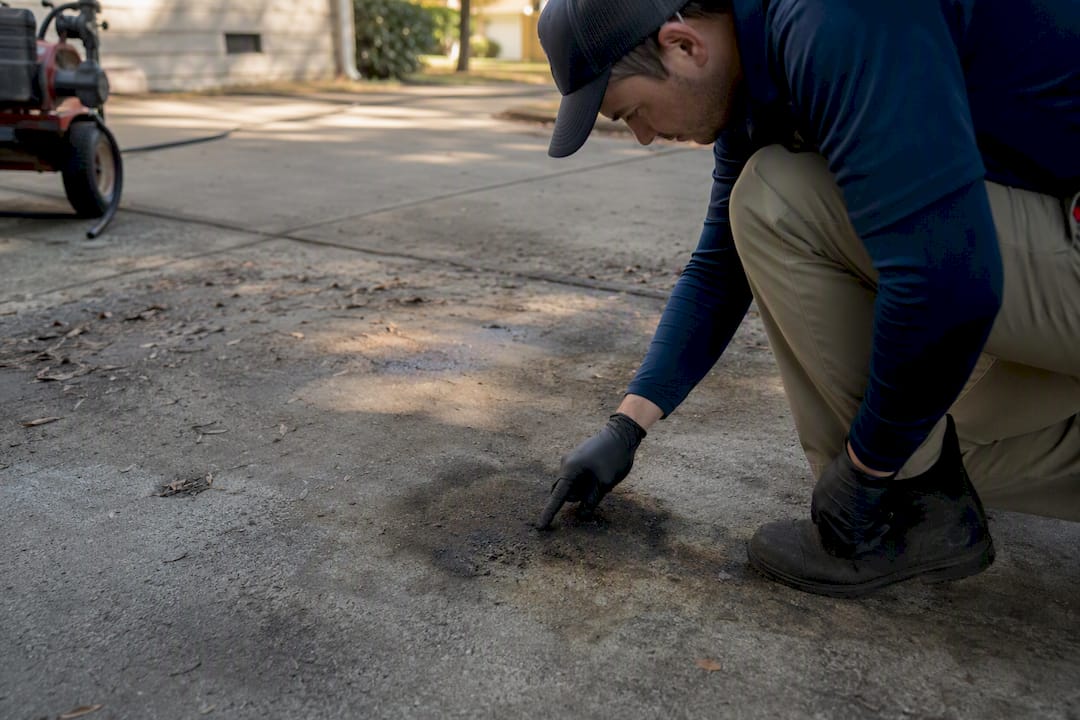
Professional crews start by assessing depth, not just surface appearance. A stain that looks identical to the naked eye can be a light surface film on one driveway and oil that’s penetrated an inch into the slab on another, and that difference decides whether the job calls for chemistry, mechanical extraction, or both.
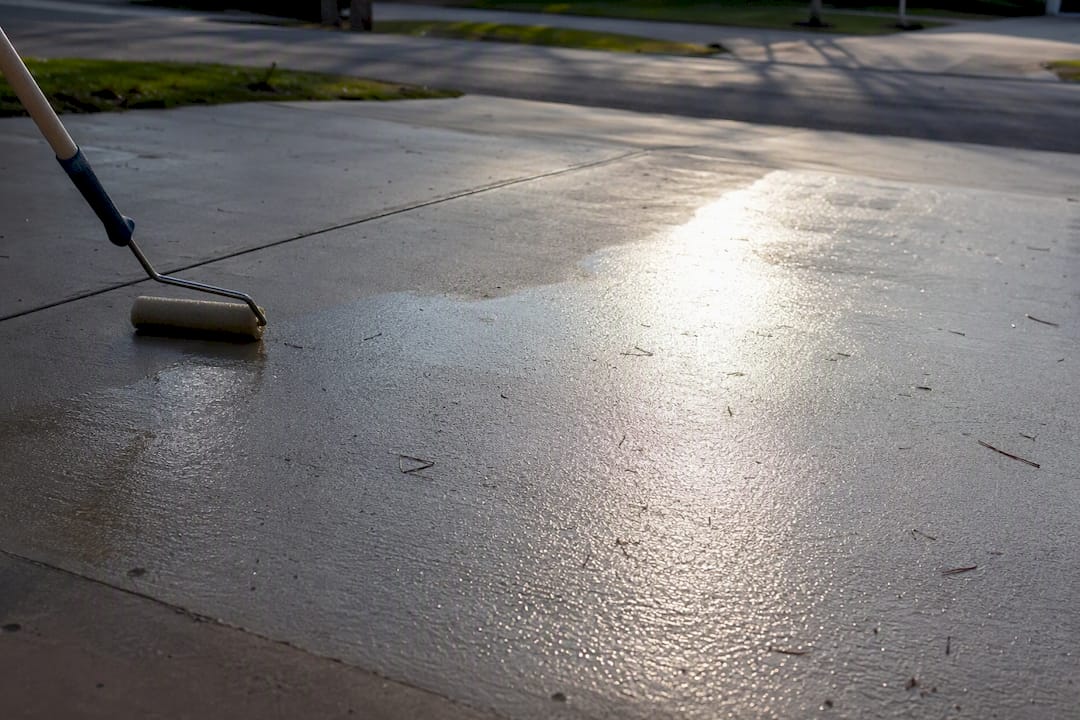
Sealing timing is where most DIY jobs go wrong. Sealer applied before the concrete has fully released trapped oil can trap that oil underneath, causing adhesion failures and a stain that resurfaces months later. Capital Pro Pressure Washing, a veteran-owned company working across the Capital Region for more than a decade, waits several days past visible dryness before sealing any driveway that had oil contamination, confirming the lift is complete rather than guessing.
The Real Lesson Buried in Every Oil Stain
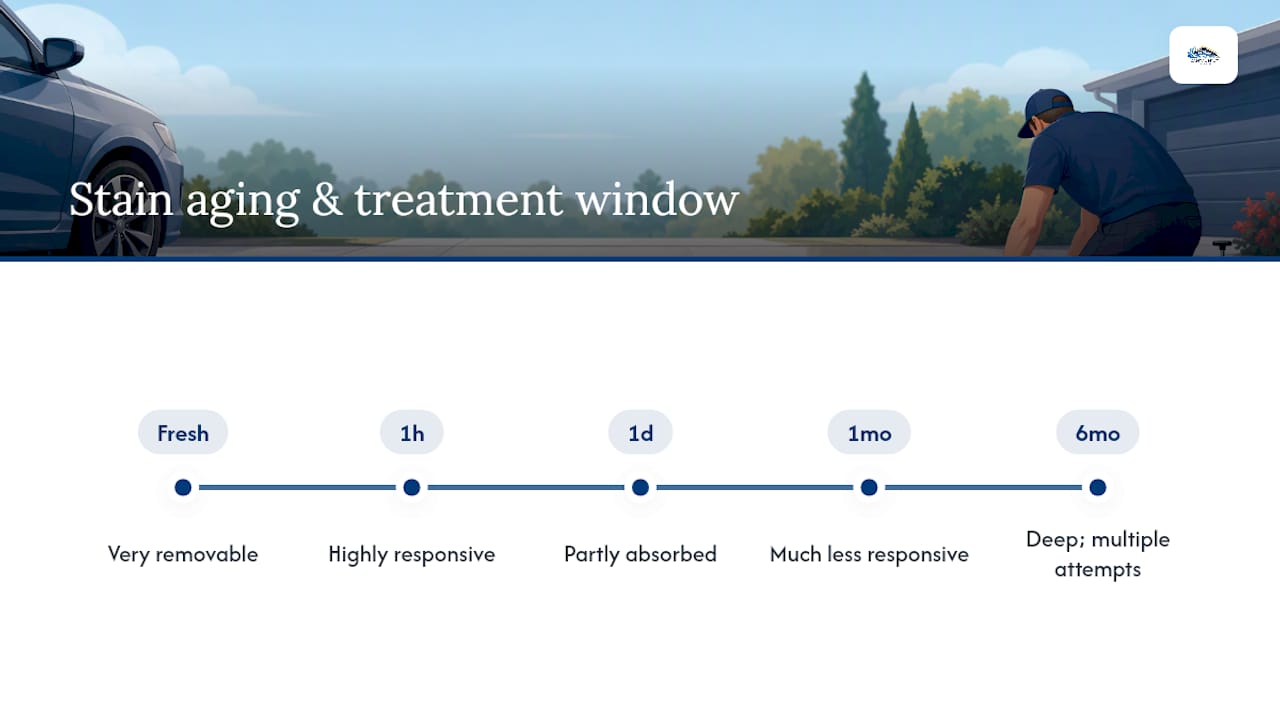
Most driveway advice treats oil removal like a single problem with a single fix: buy the right cleaner, scrub hard, done. That’s backwards. The variable that matters most isn’t the product, it’s the clock. A stain treated within the first hour behaves nothing like the same stain treated a month later, and no degreaser on the market closes that gap.
The overrated fix, in my view, is the pressure washer as a first response. People reach for it because it feels powerful, but used carelessly it can drive oil deeper into porous concrete or soften asphalt binder outright. It belongs at the end of the process, after degreasing, not the beginning.
If there’s one thing homeowners should prioritize, it’s honest stain-aging. Don’t treat a six-month-old stain like a fresh one and expect dish soap to work. And don’t assume a poultice failure after one attempt means the stain is permanent. It usually just means the oil went deeper than one cycle could reach.
— Luis T
Get Your Driveway Professionally Cleaned and Sealed
DIY works well for fresh spills and most set stains, but embedded oil on a wide section of driveway, or asphalt that’s already showing softness, is where hiring a pro saves you from making a costly mistake worse. Capital Pro Pressure Washing handles concrete cleaning, oil stain extraction, and sealing across the Capital Region, using the same dwell-time and dry-confirmation standards described above instead of rushing a sealer over oil that hasn’t fully lifted.

If your driveway has a stain that’s outlasted two or three DIY attempts, send photos, note the surface type, and estimate roughly how old the stain is. From there, request a concrete cleaning and sealing estimate and get a straight answer on whether extraction, resealing, or both will get your driveway looking right again.
Sources
- EPA — concrete cleaning guide
- PROSOCO — how to remove oil stains from concrete
- BobVila — driveway cleaning
- The Spruce — how to remove oil stains from an asphalt driveway
FAQ
How Can I Remove Oil Stains From My Driveway?
Absorb fresh spills with clay cat litter, then degrease with dish soap or an alkaline cleaner and scrub with a stiff brush. For old, embedded stains on concrete, use a poultice and expect to repeat the process once or twice.
Are Oil Stains on a Driveway Permanent?
Fresh and set stains are almost always removable with the right method. Very old, deeply embedded stains on concrete may fade significantly with poultice extraction but sometimes leave a faint shadow that only sealing or light resurfacing fully hides.
Does WD-40 Remove Oil Stains From a Driveway?
No. WD-40 is petroleum-based itself, so applying it to an existing oil stain adds more oil rather than lifting any out. Stick with alkaline degreasers or a poultice instead.
Will Dawn Dish Soap Remove Oil Stains From a Driveway?
Dawn works well on fresh spills and light set stains when paired with a stiff brush and firm scrubbing. For older or embedded stains, it usually isn’t strong enough on its own and needs to be followed by a dedicated degreaser or poultice.
Recommended
Services Related To This Article
Need a quote in the Capital Region?
Fast, free estimates from a local, licensed & insured team.
