
Moss on Roof Removal: Safe Methods That Won't Damage Shingles
The safest and most effective approach to moss on roof removal is a soft-wash chemical treatment followed by a 24–48 hour dwell period, then gentle manual clearing with a soft-bristle brush. Never use a pressure washer on asphalt shingles. Here is the short version of what to do:
- Assess safety first: Check roof pitch, surface condition, and weather before climbing up.
- Protect plants and gutters: Cover landscaping with plastic sheeting; wet plants down before and after treatment.
- Apply soft-wash solution: Use a pump sprayer to apply a diluted bleach-surfactant mix or a commercial roof cleaner.
- Wait 24–48 hours: Let the chemistry kill moss at the root before you touch it.
- Clear loosened moss gently: Use a soft-bristle broom, working downward from ridge to eave. No metal scrapers.
- Rinse low-pressure: A garden hose is enough. High-pressure nozzles strip granules.
- Dispose of dead moss: Bag it and keep it out of storm drains.
Verdict: Small patches on a walkable, low-pitch roof? DIY is reasonable with proper PPE. Large infestations, steep slopes, fragile shingles, or any active warranty concern? Call a professional.
Pro Tip: If you can see the moss from the ground and it covers more than a few square feet, treat it now. Moss holds moisture against shingles and can lift edges over time, creating a path for water to reach the decking.
Key Takeaways
Soft-wash chemical treatment followed by a 24–48 hour dwell period, then gentle manual clearing, is the safest and most effective method for moss on roof removal on asphalt shingles.
| Point | Details |
|---|---|
| Soft-wash first, always | Apply a diluted bleach-surfactant mix and let it dwell 24–48 hours before touching the moss. |
| Never pressure wash shingles | High pressure strips granules, lifts edges, and can void your shingle manufacturer’s warranty. |
| Prevention cuts repeat work | Trim overhanging branches, clear debris annually, and clean gutters to slow moss regrowth. |
| Copper/zinc strips are preventive only | Metal strips inhibit new growth but will not remove established moss already on the roof. |
| Capital Pro Pressure Washing | Veteran-owned soft-wash roof cleaning across New York’s Capital Region, warranty-safe methods, plant protection included. |
Table of Contents
- When should you remove moss from your roof?
- How to safely remove moss from your roof step by step
- What not to do when removing roof moss
- How to keep moss from coming back
- How long does moss treatment take, and what does it cost?
- When should you hire a professional instead of doing it yourself?
- What a professional soft-wash service actually looks like
- What experience has taught us about moss and roofs
- Capital Pro Pressure Washing handles moss removal the right way
- Sources
- FAQ
When should you remove moss from your roof?
Moss is not purely cosmetic. ARMA guidance warns that moss can lift or curl shingle edges, and in severe cases cause lateral water movement that leads to decking moisture damage. The question is not whether to remove it, but when.
Signs removal is overdue:
- Persistent green patches that do not dry out between rain events
- Raised or lifted shingle edges where moss has worked underneath
- Blocked drainage channels or clogged roof valleys
- Moss clumps larger than a few inches, or spread across multiple roof planes
- Visible growth on north-facing slopes that gets little direct sun
Best season for DIY treatment: Late spring through early fall gives you the dry weather windows you need. Chemical treatments work best when temperatures are mild (above 50°F) and rain is not expected for at least 24 hours after application. Avoid working on a wet or icy roof.
How roofing material changes the approach:
- Asphalt shingles are the most vulnerable to pressure and scrubbing. Stick to soft-wash and gentle brooming.
- Metal roofs tolerate slightly more rinsing force but still benefit from soft-wash chemistry to kill spores.
- Tile roofs can crack under foot traffic and pressure; a contractor with tile experience is often the right call.
- Wood shakes are porous and moss-prone; aggressive chemicals can accelerate deterioration, so lower-concentration treatments and faster rinsing matter more here.
How to safely remove moss from your roof step by step
There is no safe instant mechanical removal for established moss on asphalt shingles. The Roofing Brief recommends soft-wash treatment with a 24–48 hour dwell before any gentle rinsing or removal, and notes that pressure or mechanical force is a leading cause of shingle damage and warranty issues.
Safety checklist before you start
- Set up your ladder on firm, level ground and secure the top.
- Wear rubber-soled shoes with grip, gloves, and safety glasses.
- Use a safety harness if the pitch is above 4:12.
- Check the forecast: no rain for at least 24 hours post-application.
- Wet down all plants, shrubs, and grass within splash range before you begin.
Equipment you will need
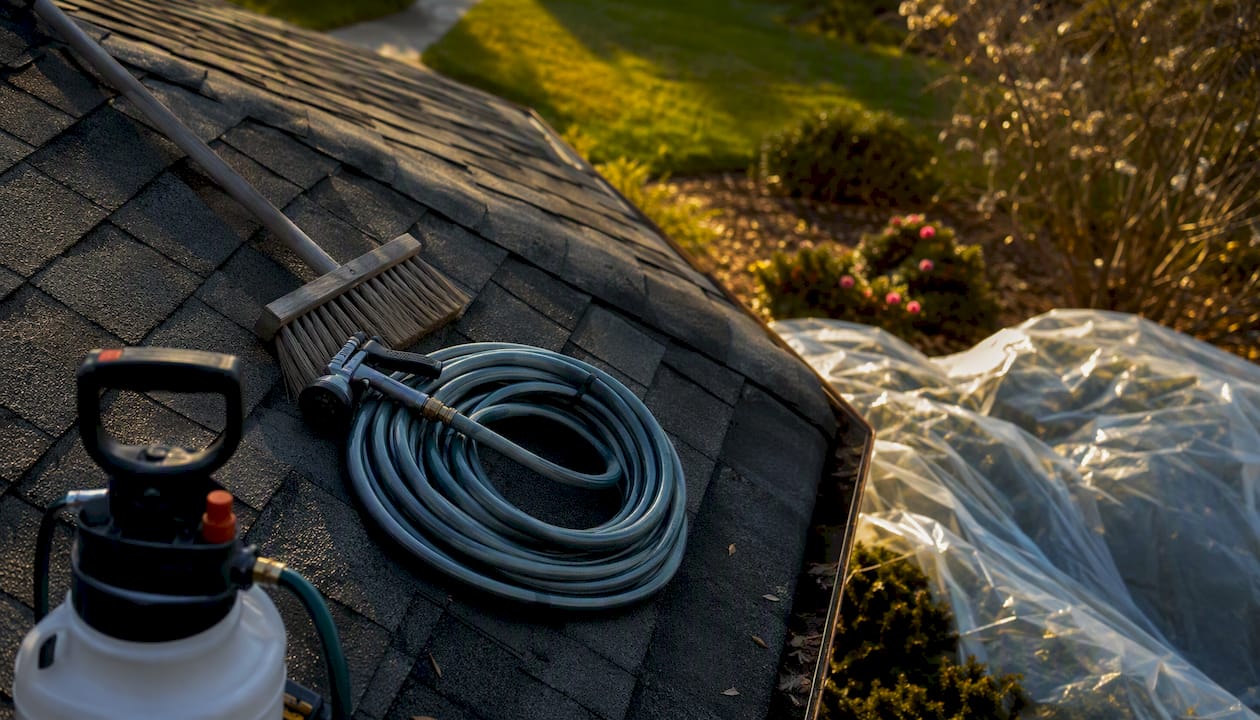
Pump sprayer or soft-wash rig, garden hose with a low-pressure nozzle, soft-bristle broom or brush, leaf blower (for dry debris pre-treatment), plastic sheeting for plants and gutters, and gloves plus eye protection.
Choosing your cleaning solution
ARMA recommends a 50:50 mix of laundry-strength liquid chlorine bleach and water as an effective cleaner for asphalt shingles, used with thorough plant protection and a low-pressure rinse. Professionals typically add a surfactant to improve dwell and coverage. For lighter patches, a diluted white vinegar solution can work, though it takes longer to show results.
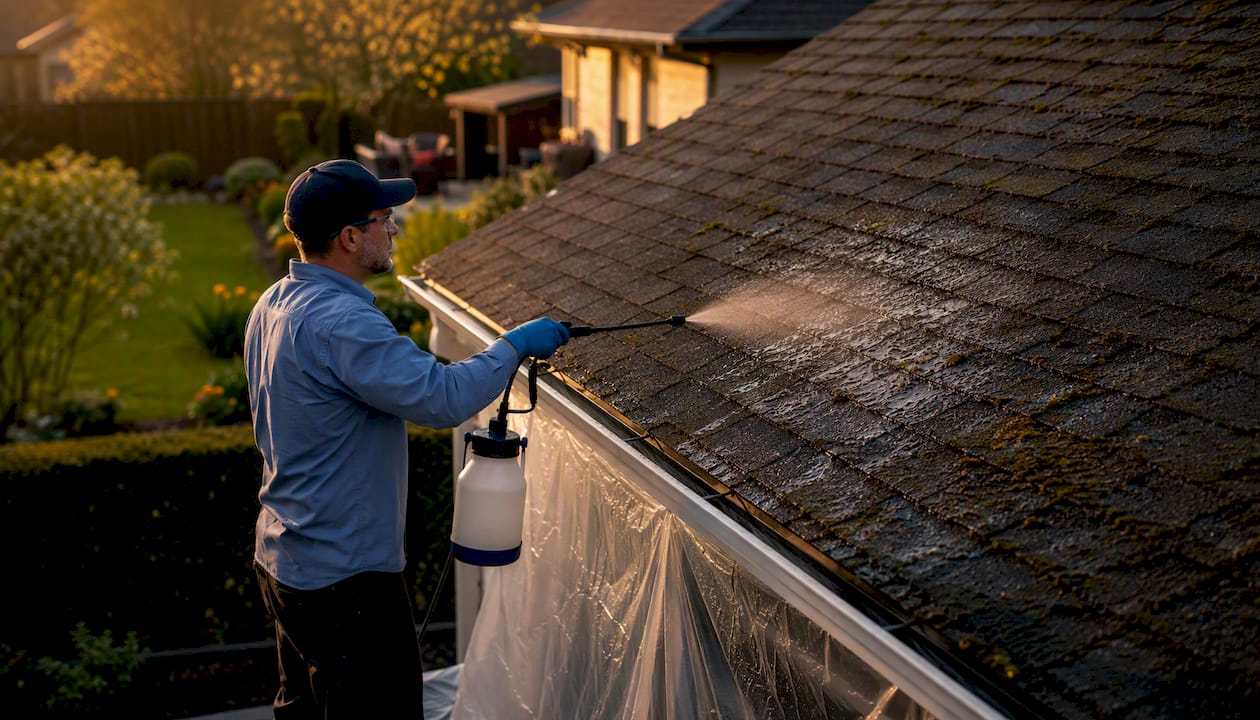
Some bleach-free concentrate products marketed for roofs take weeks or even months to fully brown and shed moss, but they carry less risk of plant damage if runoff occurs. Follow the label’s concentrate-to-water ratio exactly; stronger is not better and increases runoff risk.
Pro Tip: Before applying any bleach-based solution, pre-wet all surrounding plants and cover them with plastic sheeting. Rinse them again immediately after you finish. The EPA recommends avoiding chemical runoff into storm drains and waterways, so contain and dilute as much as possible.
Step-by-step removal process
- Clear loose debris. Use a leaf blower or soft broom to remove leaves, pine needles, and dry moss clumps before applying any liquid. Wet debris dilutes your treatment.
- Protect the surroundings. Cover plants with plastic sheeting, wet down grass and shrubs, and block gutters temporarily if you want to collect runoff.
- Mix and apply your solution. Load your pump sprayer and apply from the ridge down, saturating the moss thoroughly. Work in sections.
- Wait the full dwell time. For bleach-based mixes, 15–30 minutes is a minimum; for established infestations, 24–48 hours gives the chemistry time to kill roots. Do not rinse early.
- Gently clear dead moss. Use a soft-bristle broom, sweeping downward from ridge to eave. Never scrub across shingles or use a metal scraper.
- Rinse with low pressure. A standard garden hose is sufficient. Keep the nozzle angled downward and away from shingle edges.
- Clean up and dispose. Bag dead moss and debris; do not let it wash into storm drains or garden beds.
OSU Extension specifically instructs using a scrub brush or stiff broom and advises against high-pressure devices for shingle roofs, a point worth keeping in mind if you are tempted to speed things up.
What not to do when removing roof moss
A few common shortcuts cause more damage than the moss itself.
- Pressure washing: High-pressure water strips granules from asphalt shingles, lifts edges, and forces water under the surface. Many shingle manufacturers include language in their warranties that excludes damage caused by pressure washing. One pass with a pressure washer can age a roof by years.
- Aggressive scrubbing: Scrubbing across shingles with a stiff brush or metal scraper removes the granule layer that protects the asphalt mat from UV degradation. Once granules are gone, they do not come back.
- Dry mechanical removal without pre-treatment: Trying to rake or scrape moss off without killing it first tears shingle edges and leaves roots behind. The moss regrows faster.
- Overconcentrated bleach mixes: More bleach does not mean faster results. It increases runoff toxicity and can bleach or kill surrounding plants. Stick to the recommended 50:50 ratio or the product label.
- Ignoring runoff: Bleach and some commercial mossicides are harmful to aquatic organisms. Letting concentrated runoff flow directly into storm drains or streams is an environmental problem and, in some jurisdictions, a regulatory one.
The practical alternative to each of these is the same: soft-wash chemistry, full dwell time, and a gentle broom. Patience is the actual tool.
How to keep moss from coming back
Killing moss is only half the job. SolvePest from Oregon State makes the point plainly: without addressing the conditions that let moss thrive, shady and debris-rich surfaces, homeowners can expect to repeat removal work every 3–5 years.
Routine maintenance that makes a real difference:
- Clear leaves, pine needles, and debris from the roof surface and valleys at least once a year, ideally in fall after leaf drop.
- Clean gutters twice a year so water drains freely and does not back up against the fascia.
- Trim overhanging branches to increase sunlight and airflow across the roof surface. Even a few extra hours of direct sun per day dramatically slows moss growth.
Copper and zinc strips: Installing metal strips near the ridge releases ions during rain that inhibit new moss growth. This Old House explains that copper and zinc strips are preventive tools, not a cure. They limit new growth but do not remove established moss. For complex roofs, strips may need to be placed every 3–4 feet down the slope for consistent coverage. SolvePest also notes installation risks and environmental considerations with metal strips, so professional installation is worth considering.
Longer-term material choices: If you are reroofing, algae-resistant shingles (those with copper-infused granules) significantly reduce moss and algae recurrence. Metal roofing is inherently less hospitable to moss. Improving attic ventilation and roof drainage also reduces the damp conditions moss needs to establish.
Pro Tip: Combine your annual gutter cleaning with a quick roof inspection and a pass with a leaf blower. Catching a thin layer of moss early means a simple spray treatment instead of a full removal job.
How long does moss treatment take, and what does it cost?
Setting realistic expectations matters. A soft-wash treatment is not instant, and cost depends on several variables.
| Scenario | Typical timeline | Recommended frequency |
|---|---|---|
| DIY spot treatment (small patches) | 24–48 hours dwell; visible browning in days | As needed; inspect annually |
| DIY full-roof soft-wash | 24–48 hours dwell; dead moss falls over weeks | Every 2–3 years in shaded climates |
| Professional soft-wash service | Same dwell; contractor handles removal same day or follow-up visit | Every 3–5 years depending on shade and climate |
| Severe infestation with shingle or deck damage | Roofer assessment needed before cleaning | Address damage first; then establish maintenance schedule |
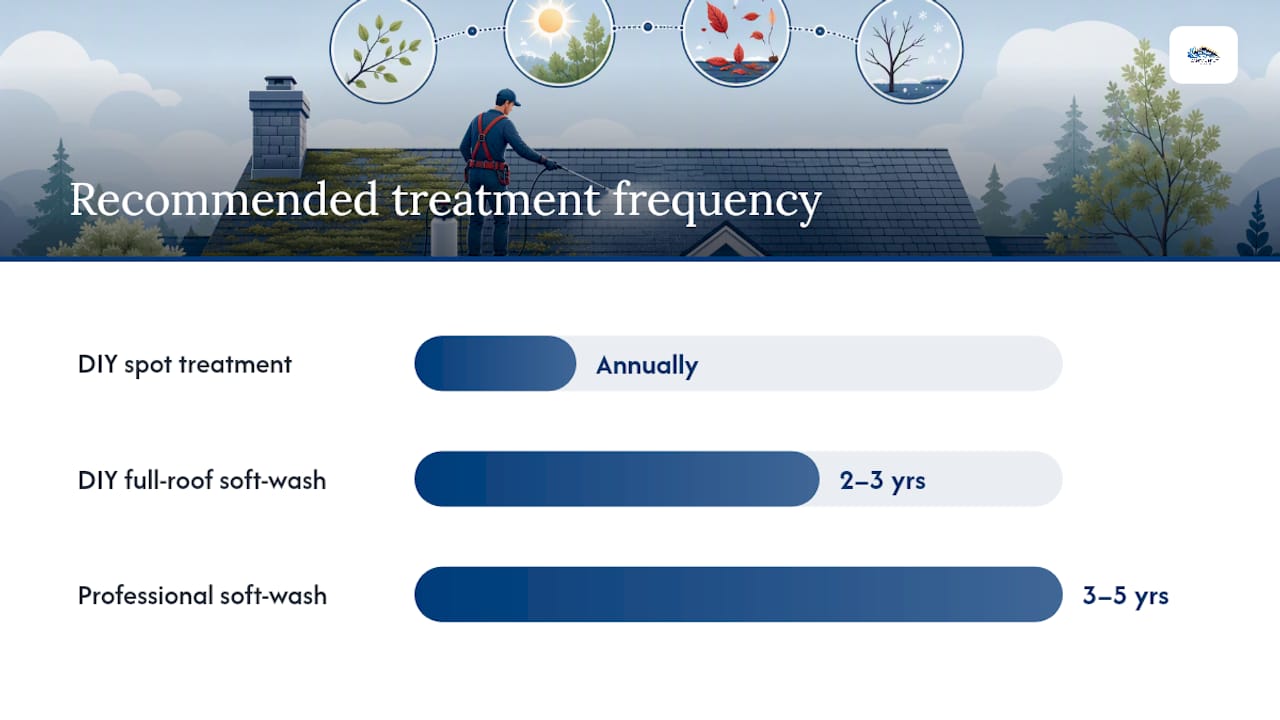
Bleach-free “spray-and-wait” products can take weeks or months to fully brown and shed moss, though they carry less runoff risk. For homeowners in heavily shaded areas, professional cleanings are commonly recommended every 3–5 years.
Cost drivers for professional service include roof size, pitch and complexity, severity of infestation, ease of access, and whether any shingle repairs are needed before treatment. A steep, heavily shaded roof with established moss will cost more than a low-pitch roof with light growth.
When should you hire a professional instead of doing it yourself?
Some roofs are not safe or appropriate for DIY treatment, and some infestations are beyond what a homeowner should handle alone.
Red flags that point to hiring a pro:
- Roof pitch above 6:12 (steeper than a standard walk)
- Fragile, aging, or already-damaged shingles
- Large or established infestations covering multiple roof planes
- Visible shingle lifting, cracking, or deck damage
- Active manufacturer warranty that could be voided by DIY cleaning
- Accessibility hazards (high eaves, complex roof geometry, nearby power lines)
Questions to ask any contractor before booking:
- Do you use soft-wash techniques, or do you pressure wash?
- What chemical products and concentrations do you use?
- How long is your dwell time before rinsing or manual removal?
- How do you protect plants and manage runoff?
- Are you licensed and insured for roof work in this state?
- Can you provide references or before/after photos from similar jobs?
- Do you offer a warranty or satisfaction guarantee on the service?
- What is your experience with my specific roofing material?
What a professional quote should include: Pre-clean debris removal, soft-wash chemical application, dwell time, gentle manual removal or low-pressure rinse, gutter cleaning, and a post-service inspection. If a contractor skips straight to pressure washing or cannot explain their dwell-time protocol, that is a clear signal to look elsewhere.
What a professional soft-wash service actually looks like
Understanding the professional process helps you evaluate contractors and know what you are paying for.
- Site preparation: The crew removes loose debris from the roof surface and valleys, protects plants and landscaping with sheeting, and covers or blocks gutters to manage runoff.
- Chemical application: Using a soft-wash rig (low-pressure pump, typically under 100 PSI), the technician applies a controlled mix of sodium hypochlorite, water, and surfactant from ridge to eave, saturating all moss-covered areas.
- Dwell time: The solution sits for the required period, killing moss, algae, and lichen at the root level. RoofScour notes that soft-wash preserves shingle granules and that results from a proper soft wash typically last longer than pressure-only cleaning, precisely because the chemistry does the work instead of mechanical force.
- Gentle rinse or manual removal: After dwell, dead moss is either rinsed away with a low-pressure garden hose or cleared with a soft-bristle broom, working downward. No high-pressure nozzles.
- Post-clean inspection: A reputable contractor walks the roof (or uses a drone) to confirm coverage, check for any shingle issues uncovered by the cleaning, and document results with photos.
A written method statement from your contractor should name the specific products used, their concentrations, the planned dwell time, and how runoff will be managed. If a contractor cannot or will not provide that in writing, the soft-wash claim may not hold up in practice.
Environmental and safety controls a quality contractor maintains: Runoff containment or dilution measures, PPE for all crew members, fall protection equipment, and liability insurance covering roof work. Ask for proof of insurance before anyone climbs your roof.
What experience has taught us about moss and roofs
Moss removal looks simple from the ground. Up close, on a damp roof with a 6:12 pitch, the margin for error narrows fast. The homeowners who call us after a DIY attempt gone wrong almost always made the same two mistakes: they skipped the dwell time because they wanted results the same day, and they used more pressure than the shingles could handle.
The soft-wash approach we use at Capital Pro Pressure Washing is not a shortcut. It takes longer than blasting a roof with a pressure washer, and we explain that to every customer upfront. What it does is kill the organism at the root, protect the granule layer that gives your shingles their rated lifespan, and keep the runoff from harming your landscaping. Those three things matter more than speed.
We work across New York’s Capital Region, and the moss conditions here, shaded lots, wet springs, mature trees close to the house, are exactly the kind that turn a small green patch into a full-roof problem within a season or two. Catching it early with the right chemistry is almost always cheaper than waiting.
Capital Pro Pressure Washing handles moss removal the right way
Soft-wash roof cleaning done by a crew that knows what it is doing costs less than a premature roof replacement. Capital Pro Pressure Washing brings over 10 years of experience removing moss from roofs across Albany, Troy, Colonie, Schenectady, and the wider Capital Region, using soft-wash techniques that protect your shingles, your plants, and your warranty.
Every job includes plant and runoff protection, the full dwell-time protocol, gentle manual clearing, and a post-service inspection. No pressure washing on asphalt shingles. No shortcuts that void your manufacturer warranty. If your roof needs more than cleaning, the inspection catches it before it becomes a bigger repair.
Ready to get your roof cleared safely? Request a free quote and a Capital Pro technician will assess your roof, explain the process, and give you a straight answer on what it will take.
Sources
- How to remove moss from my roof? - OSU Extension Service
- Moss on Roofs & Walkways | solvepest
- How to remove moss from roof? - The Roofing Brief
- How to Pressure Clean a Roof: Shingles, Tiles and Metal (2026 Guide) | RoofScour
- How to clean and prevent a mossy roof | This Old House
FAQ
What is the fastest way to remove moss from a roof?
A soft-wash treatment with a bleach-surfactant solution is the fastest safe method. Apply it, allow a 24–48 hour dwell, then clear loosened moss with a soft-bristle broom. Skipping the dwell time and going straight to scraping or pressure washing is faster in the moment but damages shingles.
Is it worth removing moss from a roof?
Yes. Moss holds moisture against shingles, can lift edges over time, and in severe cases causes water to reach the roof decking. Removing it early is significantly cheaper than repairing or replacing damaged shingles.
What time of year should you remove moss from your roof?
Late spring through early fall is best. You need mild temperatures (above 50°F), dry conditions for at least 24 hours after treatment, and a stable surface to work on. Avoid icy or wet roofs entirely.
What kills moss on a roof naturally?
White vinegar diluted with water can kill light moss growth, though it takes longer than bleach-based solutions and may need repeat applications. Copper and zinc strips release ions during rain that inhibit new growth, but they will not kill moss that is already established.
When should I call a professional for roof moss removal?
Call a pro when the roof pitch is steep, the infestation covers multiple planes, shingles are already damaged, or an active manufacturer warranty is at stake. Capital Pro Pressure Washing handles soft-wash roof cleaning across the Capital Region using methods that protect shingles and satisfy warranty requirements.
Recommended
Services Related To This Article
Need a quote in the Capital Region?
Fast, free estimates from a local, licensed & insured team.
