
Clean Metal Roof the Warranty-Safe Way: A Soft-Wash Guide
Yes, you should clean a metal roof, and the safe way to do it is a soft-wash approach: low water pressure, a mild detergent, a short dwell time, and a gentle rinse from ridge to eave. Skip the pressure washer wand, the wire brush, and the bleach jug sitting in your garage. Metal panels can handle water and the right cleaner just fine, but the wrong tool or chemical strips factory finish, triggers corrosion, and can void the manufacturer’s warranty outright.
Before you touch a hose, run through a short checklist:
- Pull up your roof panel manufacturer’s care documentation (or ask the installer for it) to confirm which cleaners and pressure limits apply to your finish.
- Pre-wet the roof and any nearby shrubs or flower beds so detergent runoff doesn’t scorch your landscaping.
- Clear gutters and downspouts first so rinse water and dislodged debris actually drain instead of pooling.
- Test any cleaner on a small, hidden section of roof and wait to see how the finish reacts before treating the whole surface.
- Set up fall protection and a stable ladder before you climb anywhere near the eaves.
Dirty roofs aren’t just an eyesore. Bird droppings, tree sap, and algae trap moisture against the panel surface, and that trapped moisture is what starts localized corrosion under the finish. Cleaning on a reasonable schedule protects the metal underneath, not just the color on top.
Key Takeaways
Cleaning a metal roof safely comes down to low pressure, a manufacturer-approved detergent, patience during dwell time, and knowing exactly which chemicals and tools are off-limits.
| Point | Details |
|---|---|
| Soft-wash is the safe default | Low pressure, mild detergent, and a 10 to 15 minute dwell time protect the finish and the warranty. |
| Clean on a schedule and by trigger | Plan for washing every three to five years, sooner after storms, tree work, or visible algae and moss. |
| Know your banned list | Skip chlorine bleach, ammonia, wire brushes, and industrial solvents unless your manufacturer explicitly approves them. |
| Watch for swarf and loose fasteners | Inspect before cleaning, since leftover metal shavings rust permanently and can’t be cleaned out later. |
| Call a pro for steep, tall, or damaged roofs | Capital Pro Pressure Washing uses soft-wash methods built around manufacturer guidance for warranty-safe results. |
Table of Contents
- How Often Should You Clean a Metal Roof?
- Safe Tools and Cleaning Agents for a Metal Roof
- Step-by-Step Soft-Wash Method for Cleaning a Metal Roof
- Treating Stains: Algae, Moss, Rust, Sap, and Grease
- Mistakes That Damage Metal Roofs or Void Warranties
- When to Hire a Professional for Roof Cleaning
- Why We Built Our Process Around Soft-Wash
- Why We Favor Soft-Wash Over Pressure-Only Work
- How We Can Help With Your Metal Roof
- Sources
- FAQ
How Often Should You Clean a Metal Roof?
Most metal roofs need a light rinse once a year and a real cleaning every three to five years, though that window shrinks fast if you live somewhere humid, shaded, or near salt air. Manufacturer guidance generally calls for freshwater washing two to three times a year under normal conditions, with more frequent attention for coastal or high-humidity climates where salt and moisture accelerate finish breakdown.
Certain events push cleaning up your priority list regardless of the calendar. A heavy pollen season that leaves a yellow-green film across the roof, a flock of birds that treats your ridge line as a regular perch, storm debris jammed into valleys, or a tree removal crew that leaves sawdust and sap behind all justify an out-of-schedule wash. Visible moss or algae streaking is another trigger you shouldn’t ignore, since both hold moisture against the panel long after rain has stopped.
Pro Tip: Clean on an overcast day with mild temperatures, ideally 60 to 80 degrees Fahrenheit. Direct sun bakes detergent onto the panel before it has time to work, and it makes the metal surface too hot to touch safely.
Timing matters for a second reason: cooler, cloudier conditions slow evaporation, which gives your cleaning solution the dwell time it needs to actually loosen grime instead of drying into streaks.
Safe Tools and Cleaning Agents for a Metal Roof
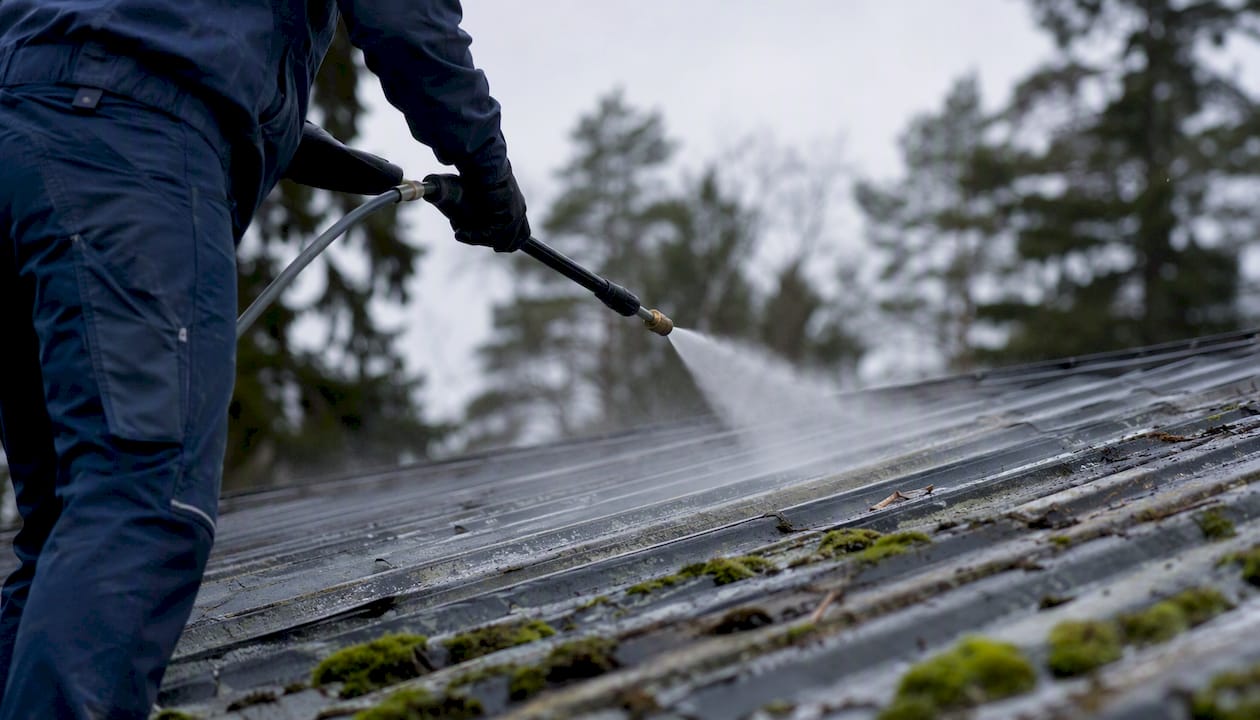
The tool list for a warranty-safe clean is short on purpose. Soft bristle brushes, non-abrasive sponges, and a standard garden hose handle the bulk of the work. If you use a pressure washer, keep it well under the panel’s rated limit. Many DIY references point to 1,200 to 1,500 PSI as a cautious ceiling with a wide 40-degree fan tip held at a distance, never a narrow jet aimed straight at a seam.
On the cleaner side, a mild dish detergent diluted in water covers most routine dirt and pollen film. Manufacturer documentation for many finishes specifies a 5% detergent solution as the standard mix. For sticky, non-water-soluble spots like tar or old sap residue, isopropyl alcohol or mineral spirits can work, but only as a spot treatment, tested first and rinsed thoroughly afterward.
Prohibited: chlorine bleach, ammonia, wire brushes, and industrial solvents. Official cleaning guidelines explicitly rule these out for routine maintenance, as they can strip or corrode factory finishes even when used carefully.
That warning matters because the consequences aren’t cosmetic. Using the wrong cleaning agent can void the manufacturer’s warranty outright, and once a finish is scratched by an abrasive pad, there’s no cleaning your way back to factory condition.
| Category | Safe to use | Avoid |
|---|---|---|
| Tools | Soft bristle brush, non-abrasive sponge, garden hose | Wire brush, abrasive pad, scouring powder |
| General cleaners | Mild dish detergent (around 5% solution) | Chlorine bleach, ammonia |
| Spot treatments | Isopropyl alcohol, mineral spirits (tested first) | Undiluted industrial solvents, strong acids |
| Pressure equipment | Low-pressure washer with wide fan tip, under manufacturer limit | High-pressure narrow jet at close range |
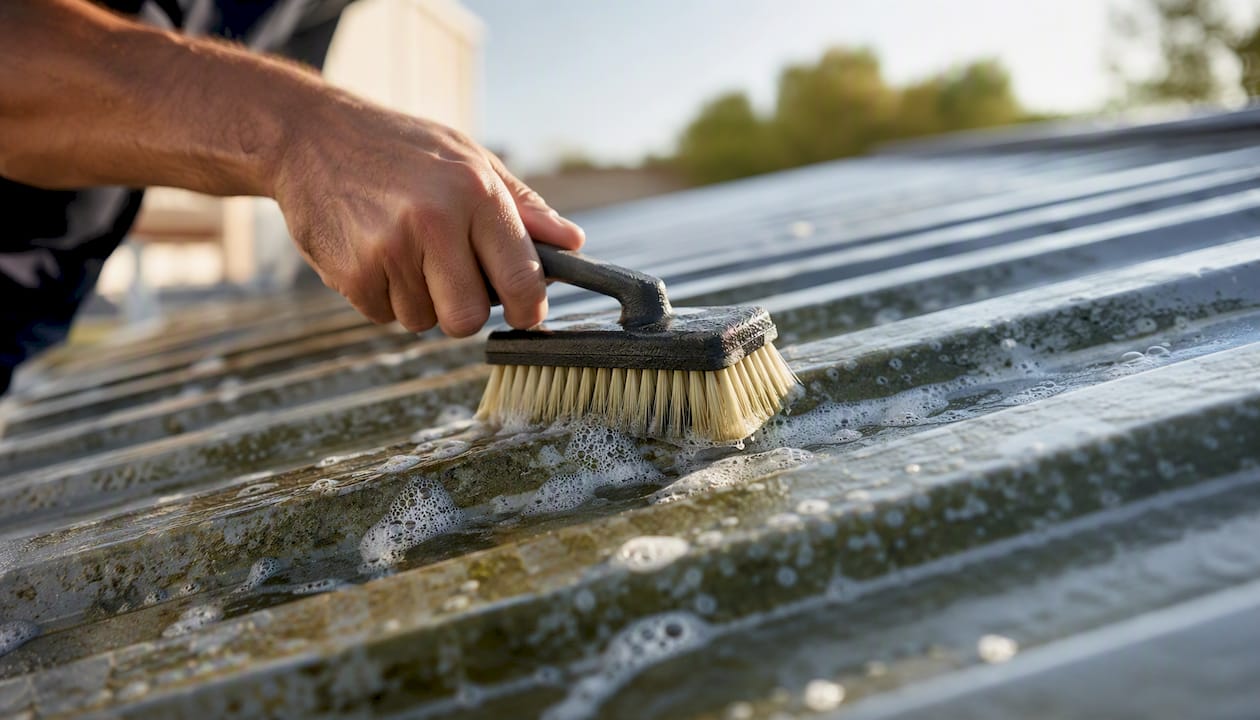
Always test any product, even one on the “safe” list, on a small hidden patch of roof before committing to the full surface. Finishes vary between manufacturers, and a cleaner that’s fine on one coating can dull or discolor another.
Step-by-Step Soft-Wash Method for Cleaning a Metal Roof
A soft-wash job breaks down into a handful of stages, and rushing any one of them is how homeowners end up with streaking, corrosion, or a voided warranty.
- Prep the site. Put on non-slip shoes, use fall protection if the roof pitch is anything but shallow, and set your ladder on firm, level ground. Clear gutters so runoff has somewhere to go, cover or pre-wet nearby plants, and walk the roof visually (from the ladder, not on foot yet) checking for loose fasteners or metal shavings left over from installation.
- Mix your solution. Combine your detergent at the recommended ratio, typically around 5% for general cleaning, in a pump sprayer or bucket with a soft applicator.
- Apply section by section. Work from the ridge down toward the eave in small, manageable sections rather than soaking the whole roof at once. This keeps the solution from drying out before you can rinse it.
- Let it dwell. Give the detergent 10 to 15 minutes of contact time so it can break down grime without you having to scrub hard.
- Agitate gently. Use a soft brush on stubborn spots. Never force water or a brush under seams or overlaps, where trapped moisture becomes a corrosion problem later.
- Rinse top to bottom. Low pressure, moving from ridge to eave, the same direction the panels shed water naturally.
- Inspect and rinse landscaping. Walk the yard afterward and hose down any plants that caught detergent runoff.
Pro Tip: If you find loose fasteners, rust starting at a screw head, or panels that flex underfoot during your pre-clean inspection, stop and call a professional. Cleaning around damage without repairing it first often makes the underlying problem worse.
Treating Stains: Algae, Moss, Rust, Sap, and Grease
Different stains call for different fixes, and treating all of them with the same all-purpose spray is how homeowners end up doing more harm than good.
Mildew and algae respond well to your standard detergent mix with a slightly longer dwell time. A dilute-bleach solution can work faster on stubborn green or black streaking, but only if your manufacturer’s documentation explicitly allows bleach on that finish, and only with an immediate, thorough rinse afterward. Skip it if you’re unsure.
Moss needs a gentler hand than most homeowners expect. Wet the area first, let the detergent soften the moss, then scrape lightly with a plastic tool. Never chisel or scrape aggressively. Metal panels scratch and score easily, and a scored coating is a permanent flaw, not a temporary mark.
Rust spots call for the shortest possible contact time. Manufacturer guidance for spot treatments typically limits acid exposure to just a few minutes before flushing with copious water. Diluted vinegar is a gentler starting point than oxalic acid and works well on many colored finishes without dulling the paint, as long as you rinse immediately and avoid bleach unless your manufacturer specifically clears it.
Tree sap and grease usually need a solvent, not detergent. Isopropyl alcohol or mineral spirits applied sparingly with a soft cloth, tested on a hidden spot first, will lift most residue. Rinse thoroughly and protect any plants below, since these solvents aren’t meant for soil contact.
When spot-treating rust on fluoropolymer finishes, contact time matters more than concentration. A few minutes with copious rinsing beats a longer soak, because prolonged acid exposure damages the surface almost immediately.
Mistakes That Damage Metal Roofs or Void Warranties
Most roof damage homeowners cause themselves traces back to one of a handful of avoidable mistakes.
- Running a pressure washer at close range or at full power strips coating and drives water under seams where it has nowhere to evaporate.
- Reaching for a wire brush, scouring pad, or abrasive powder to speed up stain removal, which scratches the finish permanently.
- Using undiluted bleach or an unspecified strong acid on a finished panel without manufacturer approval.
- Letting cleaning runoff pool in gutters or landscaping instead of directing it toward proper drainage.
- Walking on seams, trim pieces, or unsupported panel sections instead of sticking to supported flats, which risks both a fall and a dented roof.
- Leaving magnetized metal shavings, known as swarf, on the roof after installation or repair work.
That last point deserves its own warning. Swarf left behind after installation rusts on contact because the shavings are magnetized and stick to the panel surface. Once that rust sets in, it stains permanently and no amount of cleaning removes it.
Field repainting or aggressive, improperly chemical cleaning is explicitly cited as a cause of voided finish warranties, not just a cosmetic risk.
Dissimilar metal contact is another quiet warranty killer. Steel wool, certain fasteners, or even runoff from a copper gutter reacting with an aluminum panel can trigger galvanic corrosion that no amount of careful cleaning will reverse.
When to Hire a Professional for Roof Cleaning
DIY soft-washing works fine for a single-story ranch with a low, walkable pitch and no visible damage. It stops making sense the moment your roof gets steep, tall, or complicated, or when you’re not fully comfortable working at height with a ladder and harness.
Before you hire anyone, ask a few direct questions:
- Can you show proof of liability insurance and worker’s compensation coverage?
- How much of your experience is specifically with metal roofs, not just asphalt shingles?
- Do you use a soft-wash, low-pressure method, and can you name the detergents you use?
- Can you provide references from recent metal roof jobs, and a written scope of work with a guarantee?
Red flags are just as telling as good answers. Walk away from anyone who leans on pressure-only cleaning, refuses to put the job scope in writing, can’t produce insurance documentation, or brings out high-pressure equipment anywhere near panel seams. A licensed roofing contractor can also weigh in if you’re not sure whether a stain is surface grime or an early sign of panel damage that needs repair before cleaning.
The cheapest bid isn’t automatically the smartest one. A pressure-only crew that charges $150 less than a soft-wash specialist can easily cost you thousands in finish repair or a voided warranty on a roof that was supposed to last 30 to 50 years.
Why We Built Our Process Around Soft-Wash
Capital Pro Pressure Washing built its roof-cleaning process around the same principle every manufacturer care guide repeats: the goal is to remove biological growth and grime without stressing the finish underneath. That means low water pressure, a detergent mix suited to the panel’s coating, and enough dwell time that scrubbing stays gentle instead of aggressive.
Every job starts with an inspection, not a hose. Looking for loose fasteners, existing rust, or leftover swarf before applying any solution catches problems early, when they’re still cheap to fix.
A soft-wash method removes biological growth while minimizing mechanical or chemical stress on the factory finish, which is exactly the balance a warranty-conscious homeowner needs.
That approach carries through to the follow-up work too. Homeowners who want longer-lasting protection after a wash often add a roof rejuvenation treatment that seals the surface once it’s clean, extending the gap before the next full cleaning is needed.
Why We Favor Soft-Wash Over Pressure-Only Work
Pressure-only cleaning gets results fast, and that speed is exactly what makes it risky on a metal roof. A narrow, high-pressure jet doesn’t know the difference between a stubborn algae streak and a factory coating, and by the time you notice the finish looks duller in one section, the damage is already done.
We favor soft-wash because it trades a few extra minutes of dwell time for a result that holds up. A detergent given time to work loosens grime on its own, so the rinse step is closing the job, not doing the heavy lifting. That’s the difference between a roof that still looks clean a year later and one that shows new streaking within a few months because the cleaning method left microscratches that grime clings to.
The homeowners who call us after a DIY pressure-wash attempt usually describe the same thing: the roof looked great for a week, then started looking worse than before, with new rust spots showing up where the coating had thinned. Soft-wash avoids that outcome by design, not by luck.
How We Can Help With Your Metal Roof
Capital Pro Pressure Washing handles metal roof cleaning across Albany, Schenectady, Saratoga, and Rensselaer counties using the same soft-wash, warranty-safe method outlined above: low pressure, manufacturer-appropriate detergents, and a careful inspection before any cleaner touches your panels. 
Every job includes a pre-clean walkthrough for loose fasteners, existing rust, or leftover swarf, followed by a full roof washing service and, for homeowners who want longer protection, a roof rejuvenation treatment afterward. If your gutters are clogged, we can clear those first too, since a clean roof draining into a blocked gutter defeats half the purpose.
To get an estimate, have your roof type, approximate square footage, and a few photos of any visible staining or damage ready. That information lets us quote accurately without needing to guess at your roof’s condition sight unseen. Request an estimate and we’ll walk you through what your specific roof needs before any work starts.
Sources
Before you clean anything, check your specific panel manufacturer’s care documentation, since finishes vary and so do their tolerances for chemicals and pressure.
- Metal Roof Cleaning Do’s and Don’ts
- Metal Roof Maintenance Guide (MRS Roof Panel Maintenance Guide)
- How to clean a metal roof
FAQ
What’s the best thing to clean a metal roof with?
Will Dawn clean a metal roof?
Yes, a diluted dish detergent like Dawn works well as a general cleaner for a metal roof, since it cuts through grime and pollen film without the harsh chemical action that damages factory coatings.
How do you make a metal roof look new again?
Combine a thorough soft-wash cleaning with a follow-up roof rejuvenation treatment; the wash removes grime and biological growth, while the rejuvenation coating restores shine and adds a protective layer.
Should metal roofs be cleaned?
Yes, regularly. Trapped contaminants like sap, droppings, and algae hold moisture against the panel and start localized corrosion, so cleaning protects the metal itself, not just its appearance.
Recommended
Services Related To This Article
Need a quote in the Capital Region?
Fast, free estimates from a local, licensed & insured team.
